Wo Shi Laowai – Wo Pa Shui

This Blog was Invented in Xi'an 5,000 Years Ago

Archive for the ‘China’ Category

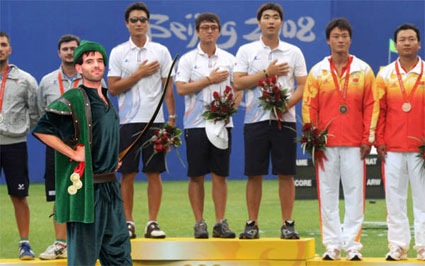
Green-Clad Archer Steals Gold From Rich, Gives To Poor

Posted by MyLaowai on Thursday, August 21, 2008


BEIJING—Chinese Olympic officials say they are no closer to catching the swashbuckling, green-uniformed archery competitor who has disrupted every single medal ceremony of the Games by bursting in, stealing the gold medal or medals in the name of the poor in an archery-related fashion, striking a triumphant pose, and then disappearing without a trace.

“Good people of the world, take heart!” the mysterious figure said in his most recent appearance, when he burst into the medal ceremony for the Men’s 200 Metre Freestyle. “Truly, these are good men, doughty and true; and their swimming has won the day. First place in the very world may they rightly claim, but in the name of the poor, the sickly, the lonely old, and the weak without voice, I hereby claim this gold that with it I may do greater good!”

The archer then shot a goose-feathered arrow through the ribbons holding the gold medals around the necks of the U.S. team, causing their medals to fall to the ground. The archer himself proceeded to leap from the rafters, alight on the podium’s top step, collect his prize, and disappear through a nearby window.

Since entering China last month by using a forged Sherwood Forest passport under the name Robert Huntingdon, the archer has appeared at more than 70 medal ceremonies, escaping with the gold every time. In almost every case, archery-related schemes were used to secure the medals, although some were more difficult for him to obtain than others.

An epic four-way fencing match broke out during the Women’s Sabre medal ceremony, with the archer taking on the three American women in a clash of blades that spilled out onto the balcony and across the Beijing rooftops. Germany’s Ole Bischoff, winner in the Men’s 81kg judo event, threw the archer through a nearby table and down a flight of stairs before his feet were nailed to the ground by arrows. And the Chinese women’s gymnastics team was almost impossible for the archer to catch.

The athletes themselves are divided in their opinion of the bow-weilding outlaw. Although many regard him as annoyance at best, and still others as a dangerous menace, a considerable faction has voiced sympathy for his cause.

“Put it this way—that guy has some stuff of mine, but he’s welcome to it,” said U.S. swimmer Michael Phelps. “I mean, I’m not political, really, but I’ve had a lucky life. If my gold medals can help someone get a hot meal and a place to sleep for a few nights, that’s okay. It doesn’t mean I didn’t win.”

Phelps confessed his admiration that, although the archer had burst into the ceremony for the men’s 400 Meter Relay, the team had been allowed to keep a single medal, as the archer praised the “epic performance by four doughty good men and true, who soundly defeated the Norman French, uplifted the hearts of all who saw, and enriched the very World thereby.”

Chinese officials have been less charitable. “His disregard for our culture, our laws, and these Games will not go unpunished,” a statement from the Chinese Olympic Committee read in part. “We demand he turn himself in, return the medals to the rightful winners, and face his punishment for these thefts, as well as for his repeated demands that we free Tibet and his continued poaching of deer in Yu Nan province.”

Law enforcement officials, acting in liaison with the Nottingham Sheriff’s Department, have also concocted a scheme to capture the elusive archer by staging an archery contest with an especially large and valuable gold medal as the prize, an event already under way. The contest is currently in the semifinal rounds and is being led by Britain’s Rob Enhood, a mysterious eyepatched figure with a penchant for archery so accurate that he routinely splits the arrows of his competitors.

– Reporting by The Onion

Posted in China | 1 Comment »

ONN Breaking News!

Posted by MyLaowai on Wednesday, August 20, 2008

Deadly Virus Sweeping China Is Just Olympic Fever

The Chinese government explained that the fatal disease is caused by the excitement of the Olympics, not infected birds, as was previously reported.

Posted in China | Leave a Comment »

Olympic FAQ

Posted by MyLaowai on Sunday, August 17, 2008

…and now this extract from the Olympic Website Since Ancient Times:

Olympic FAQ for Foreign Friends

1. I’ve been hearing a lot about these pollution levels, but there are so many different ways the experts use to describe it all, and so much fancy jargon, that I’m a bit confused. Can you please tell me what is the standard that Beijing must meet to determine whether it is a “blue sky day”?

Certainly. It is a “Blue Sky Day” if the sky is Pantone 444M or better.

2. Is there an official Olympic song?

Indeed yes! There is an official song, and it will be sung at every event before athletic activities commence, before and after every medal presentation, in the taxi on your way home to your hotel, during the night in your hotel room, from loudspeakers along every street, and from the micro-radio that will be implanted in your teeth at the airport during customs inspection. It’s a lovely little ditty, too. Here it is:

Ni ke Cen Jian Guo Yi Wei Xiao Jie?
Yi Wei Xiao Jie.
Yi Wei Xiao Jie?
Ni ke Cen Jian Guo Yi Wei Xiao Jie?
Wang Zhe Bian Zou he Na Bian Zou?
Wang Zhe Bian Zou he Na Bian Zou
Na bian Zou he Zhe Bian Zou
Ni ke Cen Jian Guo Yi Wei Xiao Jie?
Wang Zhe Bian Zou he Na Bian Zou?

3. What’s the deal with the mascots? Why so many, and what are they called anyway?

Actually, there is some confusion regarding both the name and number of Olympic mascots at the 2008 Genocide Olympic Games. Originally, there were five mascots, however one defected from the team. Sadly, therefore, Yingsel will not be present. As for their names, the mascots have been variously referred to as Funtwo, Fuzbol, and even Futzpah. Most foreign media have now settled on the term Fuwa, which is unfortunate, as the term has the same sound in Chinese as scrotum.

4. What’s the best way to support the athletes from my own country, without hurting the feelings of all the Chinese People?

You must take extreme care at all times to avoid hurting the feelings of all the Chinese People. This includes such things are not arguing over prices (which suggests that you think the honest merchant you are dealing with might not be 100% honest), not pushing in front of Chinese People in queues, or bringing up the subject of your incorrect understanding of history. In an effort to help you out, the Chinese Communist Party has hired people to cheer for your athletes on your behalf, in order that you will not run the risk of hurting anyone’s feelings. These ‘Cheerers’ are expected to be so diligent, that you in fact will not be required to attend any of the actual events in person, which is why your Visa application has been denied.

5. Will the foreign media be allowed to cover my favourite events?

Of course they will. You will be able to freely watch Ping Pong, Badminton, and Air-Pellet Shooting, as well as any other event in which China wins a medal. In case you miss it the first time, regular repeats will be scheduled.

6. What is the IOC doing to stop drug cheats?

The IOC has full confidence in the Chinese Communist Party’s ability to closely monitor any relevant situation, according to certain relevant Laws. The Chinese Team has already said that they are clean, and so obviously the job of catching cheats will now be confined to catching the foreign cheats who manage to win any medals. Some foreigner cheats have already been caught, when the company in Guangdong that produces their food confirmed that it was laced with anabolic steroids.

7. Where can I buy tickets?

You can purchase tickets from scalpers outside any Olympic Venue. The tickets will not help you to actually get in, but then as a laowai that should hardly come as a surprise. A better bet, would be to have parents who are members of the Chinese Communist Party.

8. Where is a good place to stay during the Olympics?

Home.

9. Where can I go to Party party in Beijing?

That will depend very much on whether you look like you might have come from a certain continent whose resources are being plundered by a certain Asian nation. If so, you will have a wonderful chance to party at Zhengding Detainment Center. If you are instead from Western, then the bars will be closed anyway, in order to show stable and calmly. No dancing, prease.

10. What can I do to show my support for One World, One Han Dream?

Simply this: Do not display Evil Motives against the peaceful People’s Liberation Army and 5,000 years civilisation of China.

Welcome to China, wish you happy happy everyday!

Posted in China | 2 Comments »

Chapter 12: In which the author strings together a series of sub-standard puns vaguely related to the Olympics

Posted by chouchoulaowai on Thursday, August 14, 2008

The Olympics. Ever since that first finely oiled naked Greek boy was taken behind the Parthenon and shown where to plant his javelin, it has been a regular 4-yearly occurrence in our lives just like Leap Years and unwanted marriage proposals from women. Those shiny multi-coloured entwined rings mean many different things to many different people. To some, the Olympics evokes nostalgic memories of men in white jogging shorts running in slow motion across a beach to Chariots of Fire. To others, the Olympics will always be Her Royal Highness The Princess Anne having an East European physician stick his hand down her royal knickers in order to assess if her crown jewels weren’t the result of gender bending Soviet wizardry. However, to me, secure here in my beautiful English retreat of Asbestos-Upon-Trent, the Olympics will always mean one thing: having all my favourite afternoon cartoons rescheduled for at least three fucking weeks. Spongebob pissing Squarepants.

Forgive me, dear reader. I am being flippant. Of course, the Olympics are a much more serious affair than the above. More than anything, it is a wonderful opportunity to partake in that wonderful British pastime of Hurting The Feelings Of The Chinese People™. Not that Hurting The Feelings Of The Chinese People™ (or HTFOTCP for short) is a difficult procedure. Only last week, I rearranged my living room furniture and an angry mob of Sichuanese undergraduates burnt down my hanging baskets. However, HTFOTCP is an important duty that every White Supremacist should not shirk, so Olympian size opportunities should not be missed.

The first thing you should check if you want to commit some serious HTFOTCP is the colour of your skin. Yes, just by being born black, you are creating a physical affront to the Han’s shaky hold on reality. Not only are you 802% more likely to take a shiny gold medal from a deserving Sinolympian than a feeble white man; but your very existence is proof that we aren’t all descendants of the Dragon Emperor, nor can we all be classified in their chart of 56 Happy Nationalities. Plus, everyone knows that Chinese people and black people are big fans of chicken, and until Popeye’s or Nando’s sets up shop in the Middle Kingdom, there just won’t be enough of the clucking stuff to go round. In the upcoming Chicken Wars, the inheritors of compasses and paper will be shitting themselves when confronted with the race that brought us Mike Tyson, Samuel L Jackson, and that little guy from Diff’rent Strokes. By being black you are insulting the Chinese people, period. You might as well stick a lampshade on your head, slant your eyes, and bang a gong in Hu Jintao’s face.

But who gives a shit anyway? The Olympics has got to be the most boring event created in the history of man. Exactly how much can one television commentator talk about such nondescript events as Ping Pong (two chaps whack a ball to and fro), Badminton (two chaps whack a shuttlecock to and fro) and Human Rights (two chaps whack a Tibetan to and fro)? It has to be the sporting equivalent of going round to visit a boring and vapid couple who have just had a baby and watching the little bastard run round in circles and falling over, all the while listening to the inane parents say “Look, he’s just ran round in a circle and fallen over!” Why should I show my respect to some so-called gymnast who can stand on one leg for half an hour? All that proves is that he had no childhood and was probably raped once by an unscrupulous gym instructor. Hell, my Uncle Arthur can stand on one leg for half an hour, and he didn’t win any medals – well, apart from that medal he won in WWII for having his leg shot off.

It’s time we cancelled the Olympics and replaced it with something more meaningful; like a cardigan, or broadband for the Welsh. It’s a meaningless, expensive joke that accomplishes nothing apart from allowing the winner of the 400 meters to gain a 12 month contract as the face of Pepsi Cola. If you want further proof that the Olympics is a waste of time and money, just look at the name the Chinese have given to their main stadium – The Bird’s Nest. If I remember correctly, a nest is created by a bird spitting and vomiting all over a bunch of twigs in the vain hope that they will stick together. Replace the word “twigs” with “people” in that last sentence and you’ll have a good idea of the true cost of the Olympic Games to China. If the Chinese really want to continue the charade of boring everybody and wasting loads of money every four years – they should start holding general elections instead. Ahahahahaha.

Spongbob Squarepants rescheduled to 2am? What were the BBC thinking of?

Posted in China | 7 Comments »

The One By LangLang

Posted by langlanglaowai on Monday, August 11, 2008

OPENING SCENE: Central Perk Coffeehouse

Ross walks into Central Perk with his head down and a depressed look on his face.
Ross: (sadly) Hiiiiiiii
Rachel: What’s wrong, Ross?
Ross: Oh ……..I just got a phone call. (Yells joyfully) I’M GOING TO BE THE KEYNOTE SPEAKER AT THE PALAEONTOLOGY CONFERENCE IN BEIJING! WOOHOO!
Rachel: Oh, that’s great! Congratulations!
Ross: And there’s more! As a bonus, they gave me these 6 passes……. TO ALL THE OLYMPIC EVENTS! CAN YOU BELIEVE IT?
Monica: OH MY GOD! Hey, we should all go. I haven’t seen Chandler for 6 months. I can use some of that good lovin’.
Phoebe: Yeah, I still can’t believe he fell asleep during a meeting again and agreed to head up his company’s Shanghai office
Rachel: That’s a good idea. I could use some time away from Emma. She’s starting to be a real bitch.
Monica: Plus we can visit Joey. It’ll be just like old times.
Rachel: Yeah, poor Joey. After they cancelled his spinoff show he got so depressed he moved to China. I hear he’s an English teacher now and is a DJ at some disco on the weekends.
Phoebe: Well, count me out. Right before my mom committed suicide I promised her I wouldn’t go to China until Tibet is free.
Rachel: Where is Tibet, anyway?
Phoebe: Hmmmm………. South America?
Ross stares at them blankly
Ross: (sarcastically) Yes, that’s correct

ROLL OPENING CREDITS AND FRIENDS THEME SONG (By: The Rembrandts).

THE ONE IN BEIJING

SCENE 1: A classroom at the DOS English School in Hangzhou.

Joey: NO! NO! NO! It’s not “how you DOIN’?” It’s “how YOU doin’?” Let’s try it again. How YOU doin’?
Class: HOW you doin’?
A ringtone of the opening bars of ‘I’ll Be There For You’ (By: The Rembrandts) goes off on Joey’s mobile phone.
Joey: Wei?
Estelle: Joey, it’s Estelle. How ya been kiddo? Listen, I got a job for ya…
Joey: Estelle? I thought you were dead.
Estelle: It’s possible but not unbelievable. Besides, this is all in Lang Lang’s head. Look, do you wanna know about the job or not?
Joey: Sure! Whaddaya got?
Estelle: NBC wants some celebrity guest announcers for the Olympics. So far, Paris Hilton, Gary Coleman, Larry The Cable Guy, Steven Seagall and The Man Who Met Andy Griffith are all onboard. Are ya interested?
Joey: Hell yeah, sign me up!
Estelle: You got it. Good luck kiddo. Knock ’em out.
Joey turns back to his class.
Joey: Now, in English, if we want to say something is really great, we say “It’s abysmal.”
Class: It’sa abysmal

SCENE 2: The cabin of a China Air 747 jet

Ross: …………….and so, in conclusion, due to the sediment flow rate of the alluvial strata from the Protozoac Era and Post Punk Era, the fossils found at the Peking Man Site have been widely discredited and validates my theory that Piltdown Man was actually the first true species of Homo Erectus indicating…
Rachel: Oh Ross, can you just give it a rest? You’ve been going on and on and on for 6 hours already!
Ross: Hey, you’re the one that said you would help me practice my speech.
Rachel: Yeah, well, if I hear about trilobytasaurus one more time, I’m just going to freak out! It just freaks me out!
Ross: I’m sorry. Maybe we should just………… take a break.
Ross: Fine by me!

SCENE 3: The arrival gate at the new Beijing Airport

A pretty Chinese lady is holding a sign that reads ‘Dr. Ross Geller’ It is Ross’s former girlfriend Julie.

Rachel: Julie? What are you doing here? It’s good to see you.
Julie: I live in China now. I’m the dean of the palaeontology department at Beijing Abnormal University. Actually, I’m the one that pulled some strings to have Ross appointed as the keynote speaker at the convention. But I’ll be honest. I only did it because I was hoping he would bring you. I haven’t stopped thinking about you ever since I left New York. Do you think Ross ever suspected our night of unbridled passion?
Rachel. Not a chance. Actually, I’ve been thinking about you too. That was the most special night of my life.
Julie: I’ve got champagne and sunflower seeds back at my place. Care to join me?
Rachel: I’d love to. But what about Ross?
Julie: (giggling) Let’s ditch him.
Rachel: Ok!

They skip through the airport, holding hands and giggling like schoolgirls.
A montage of scenes switching between Julie and Rachel making love and frolicking around some of Beijing’s most famous landmarks, acting silly, and enjoying some of the Olympic events (especially women’s soccer and beach volleyball) is set to the music of REO Speedwagon’s ‘I Can’t Fight This Feeling Anymore’

Meanwhile Ross, separated from Rachel after having been caught in the middle of a mob of zhongguotongs that had jumped out of their seats to grab their bags from the overhead bins as soon as the wheels touched the runway, is wandering through the airport looking for her. In the confusion, a pickpocket has stolen his wallet and mobile phone The snippy girl at the China Air counter has just informed him that his bags have been bumped to a later flight. Walking in a daze he accidently bumps into a longhaired Italian guy. He turns around and they recognise each other.

Paulo: Rossa! Marinara. Tutti spumoni frutti pesto. (English translation: You fucking horse-faced buttmunch).
Ross: Paulo. Gee, I never expected to see you here. Have you seen Rachel around by any chance?
Paulo: I teacha the English. I worka the sama schoola witha Joey.
Ross: Oh…… great. Listen, I’m having a bit of a problem. Can you loan me a few bucks? I’m promise I’ll pay you back as soon as this all gets straightened out
Paulo: Vafanapoli! Palermo pizzaria roma. (English translation: Go fuck a goat! Suddenly I’m your new bestest friend. If there was a fire, you’d save me first and then your whole family, right? I wouldn’t loan you a wooden nickel)
He makes the insulting Italian gesture of throwing his fist up from under his other arm and storms off. Ross dejectedly walks away, almost in tears.

SCENE 4: The NBC broadcasting booth at the Bird’s Nest Stadium

Bob Costas: And joining us in the booth today we have a special celebrity guest. Why, it’s Joey Tribbiani from the hit TV series FRIENDS and the not so hit show JOEY! Thanks for joining us Joey.
Joey: WOW! Are those nachos?
Bob Costas: So, Joey, what is your favourite Olympic event?
Joey: Well Bob, I like to watch the women’s gymnastics. I mean, can you imagine the sexual positions those gymnasts can do? They’re really bendy. How YOU doin’?
Bob Costas: Joey, you know, most of those girls are like….. 12.
Joey: Well let’s see……… I’m 38. So when I’m 76, they’ll be 24. And I see tons of 70 year-old dudes with 20 year-old babes around here. Especially up there in those CCP and IOC luxury suites. DAMMIT! Why doesn’t this country have any decent nachos?
Bob Costas: What about other sports? Do you like archery?
Joey: I wonder if it hurts when those girls fall on the balance beam and land straight on their crotch.
Bob Costas: Uh……………… OKAAY! That was Joey Tribbiani, formerly Dr. Drake Ramoray of the daytime soap opera Days Of Our Lives. Thanks for stopping by…
Joey: What? I got to leave now? But I just ordered a meatball sub!
Bob Costas: Security!
Joey is immediately swarmed and dog-piled by about 20 PLA troops and undercover police
Joey: HEY! LET GO OF MY MISTERS!

SCENE 5: Pudong Airport, Shanghai

Monica sees her former boyfriend, Richard, walking through the airport.
Monica: Richard? It’s me, Monica.
Richard: Monica? Wow, I almost didn’t recognize you. You look…………. different
Monica: Yeah, after Chandler got sent to Shanghai, I kind of put on a little weight. I ate an Oreo every time I got horny, to try to compensate for lack of sex. I ate a lot. Lot-lot-lot.
Richard: Really? How much weight did you gain?
Monica: 235 pounds. So, what are you doing here?
Richard: I come here every August to give free eye surgery and glasses for the poor.
Monica: (adoringly) Awwww… Oh, there’s Chandler. Hey Chandler! Over here! Look, it’s Richard!
Chandler: Oh my god, Monica. Could you BE any more fat? And where are the twins?
Monica: Uh…….. I ate them. (sobbing) I’M SO SORRY!! I ran out of Oreos.
Richard: Well, I’d better catch my flight to Qinghai. Nice seeing you guys again.
Monica: Bye Richard! (She gestures her hand like a phone and mouths the words ‘Call Me’)
Richard: (smiles, strokes his moustache and walks away, whispering under his breath) Chandler, you poor bastard.
Monica: So, there’s a broom closet over there. I think we have time to knock out a quicky before we meet Joey and catch our flight to Beijing.
Chandler: Uh……… no thanks… Maybe another (he coughs the word ‘life’) time.
Monica: (shaking her hips and moving her hands down her sides) You mean you don’t wanna get-with-this?
Chandler: Whoa, take it easy there Michelin Mon.
Monica: (angrily) WHAT?
Chandler: Look! Joey’s here!
Joey: DUDE!
Chandler: DUDE!
Monica: Ok. Dude alert.
Joey drops his bags and gives Chandler a million-dollar, back-slapping hug.
Monica: Well, I’ll leave you 2 girls alone. I’m gonna go find the ladies room. I gotta pee.
Chandler: Yeah, well be careful. Those toilets were sooooo designed for Chinese-sized asses, not………. reindeer….. sized……… asses.
Monica scowls at Chandler as if he were toilet film and then uses the FRIENDS way of flipping the bird by clapping her fists together 2 times, then stomps off.
Chandler: I still got it!
Joey and Chandler laughingly do the finger-pull hi-five thingy.

SCENE 6: Inside the ladies restroom at Pudong Airport

All the toilet stalls are full. Monica is holding her crotch and shaking with pain trying to keep from peeing in her pants. Finally, a toilet flushes and a girl vacates one of the stalls. Monica walks quickly towards the stall when suddenly Zhang Ziyi cuts in front of her. Monica taps her on the shoulder.
Monica: Excuse me, I believe I was next in line.
Zhang Ziyi: This China, you fat laowai. There no line. Don’t you know who I am?
Monica: You listen here, missy! I’ve been waiting here a long time.
Zhang Ziyi: I know kung fu. You don’t want fight me.
Monica: Maybe I do. I’m pretty feisty. Slut!
Zhang Ziyi: Tramp!
Monica grabs Zhang Ziyi’s neck and shoves her face into the toilet. A giant splash of toilet water accidentally flies straight into Monica’s mouth. Zhang Ziyi jumps up and gets into a fighting stance and aims a couple of roundhouse kicks at Monica’s head without effect. She is clearly outmatched (and outweighed). Monica grabs her and puts her in bear hug.
Monica: (with a Mexican accent) ANACONDA SQUEEZE!
Locked in a life or death struggle they thrash around the room, neither willing to surrender. Suddenly, Monica slips on a giant gob of yellow phlegm and lands directly on top of Zhang Ziyi ( all 337 pounds of her), nearly crushing the life out of her and fracturing several bones. Monica gets up to walk away. Stops. Then grabs one of Zhang Ziyi’s ears.
Monica: You know, if we were in prison you would be, like, my bitch.
Zhang Ziyi: (sprawled on the floor, her body the texture of tapioca pudding, moaning with pain) ooohhhhh………….s hiiiiit…..

SCENE 7: Zhongshan Park

After several days of wandering around Beijing, an unbathed, unshaven and generally dishevelled Ross is nearly at the end of his mental rope. He lies down to take a nap on a park bench. Suddenly, a gust of wind blows a business card onto his face. He looks at it but it is written in Chinese. He drops it on the ground. The card flips over and lands on the ground revealing the other side, in English. He recognises the name on the card.
Ross: Oh my god! Julie? She’s here in Beijing?
With a renewed energy he stops a Beijing resident and throws him off his bicycle.
Ross: (pretending to flash a police badge) Beijing PD! I’m commandeering your vehicle! He pedals away as fast as he can.
Park Security Guard: Hey, that gweilo just stole your bike!
Beijing Resident: It’s ok. I can just steal another one. He hands the guard a 5 kuai bill
Park Security Guard: That red 10-speed over there is pretty sweet. The guy won’t be back for hours.
Beijing Resident: Thanks.

Exhausted and breathing heavily Ross throws the bike down and runs full throttle up the stairs of one of the staff apartment buildings at Beijing Abnormal University.

SCENE 8: Julie’s apartment

Julie hears a pounding and opens the front door
Julie: Ross? What are you doing here? Quick! You’ve gotta get out of here!
Ross: Oh Julie, I can’t tell how glad I am to see you. You have no idea what I’ve been through.
Julie: Ross, this is kind of a bad time. I’m really busy. Can you come back later?
Ross: But…… but……
A voice comes from Julie’s bedroom
Rachel: Juuuuliiieeee. I have a surprise for yoooouuuu.
Ross: Hey, that sounded just like Rachel.
Julie: (nervously) Uh….. uh….. no. It’s just the TV.
Ross: Wait a minute. He pushes past Julie and goes into the bedroom and finds Rachel on the bed, naked, except she’s wearing a huge strap-on dick. WHAT IN THE NAME OF RUBBER CEMENT IS GOING ON HERE?
Julie: Ross, I can explain!
Rachel: HEY! WE WERE ON……. A BREAK!!!
Ross:(gazing up to heaven) Are ya kiddin’ me?

EPILOGUE: Phoebe, Ross and Monica are lounging on the couch back at Central Perk
Phoebe: Wow, Monica, look at you! I can’t believe it!
Monica: I know!
Phoebe: What happened?
Monica: I caught dysentery! Isn’t it the best thing ever? I spent 2 weeks wishing the toilet had a seatbelt, but look at me now! I’m back to my Season 3 weight.
Ross: So Pheebs, what have you been up to while we were gone?
Phoebe: Oh, great news! Mike got a gig playing keyboards for that really cool band called Dulang on their world tour…
Ross: Oh, I love those guys! Does he get to talk to Cissy? Mike is soooo lucky!
Phoebe: Yeah, I know. He just called me from Tierra Del Fuego. But before he left we broke into the NYU Laboratory and released 50 spider monkeys and a French poodle. Actually, the poodle just laid there and licked his balls. But the spider monkeys ran up a tree right above some pro-China demonstrators and pelted them with faeces.
Ross: Ahhh, good times.

Posted in China | 9 Comments »

An Open Letter to the People of China

Posted by taitailaowai on Friday, August 8, 2008

Dear People of China,

I am writing to you for two reasons; firstly to congratulate you for the remarkable restraint you have shown whilst your government has spent countless Trillions of your hard-earned tax money on what is, let’s face it, two weeks of sports that rarely attract any attention except for once every four years. Secondly I would request that you exercise this same restraint once the games have come to an end.

You are to be commended, People of China, for your enthusiasm for the Olympic games, an event which, take the 2012 London Games as an example, in any other country is viewed by the general public as a massive waste of public time and resources, and a huge burden to the tax payer. The British Government are as complicit as your own in trying to dupe the public, don’t get me wrong; in the UK it is billed as a vehicle for regenerating impoverished areas, whereas in China it is billed as a show-case, a “coming out party” if you will, for China and the Chinese people, and to demonstrate both the economic miracle of the last couple of decades, and the openness and transparency that the Government has achieved during the same period.

The games are necessary for your country to demonstrate that it is a true Super-Power, after all you have an incredibly robust economy, you have the Atom Bomb, you have a massive and growing rift between the haves and the have-nots. What else was there to achieve? So it touches me greatly that you are able to stand by, without so much as a grumble, while your government tears down the cultural heart of your capital city, and removes residents from their homes in order to pave way for the building of a successful two-week festival of funny walking events and synchronized swimming.

I have nothing but praise for you too, for unquestioningly taking your cars off the roads for a few weeks in order that the Olympic athletes have something akin to semi-breathable air for the 14 or so days they will be guests in your country. It is not a concern of yours, and neither should it be, that your children have been breathing a toxic soup of deadly chemicals from unregulated industry, transport, and construction, for the last decade and more. No, the identikit men in dark suits who sip tea in ZhongNanHai know best, and have always known what is best for the people. After all, they wouldn’t want to hurt your feelings now would they?

So, it is with the pride of a father seeing his son hit a cracking drive through the covers, that I see you wearing your I Heart China T-shirts with such joy, a look of anticipation and dare I say it pride on your own faces. Yes, this is truly China’s hour, this is the start of the great things to come.

Except, what is there to come?

Since 2001, when the Olympics were awarded to Beijing, this country has focused entirely on building up public enthusiasm for the Games, and to making them the best possible success. But afterwards, what is there to look forward to? Once the last medal has been awarded and the athletes, tourists, and press have all gone home, once the last broadcast has been aired, and the last article in the Sports pages has been replaced by the latest English Premier League news, what is next? What will the countdown clocks be counting down to?

Be wary, People of China, about what will come next. Do you expect that any openness and transparency that the government has been forced to exercise because of the Games will remain in their wake? Do you expect that the cleansing of the air in Beijing will be of significant importance once everyone has gone home? Do you think that any semblance of even those tiny cracks of freedom which may have opened up because of the Olympics will be allowed to stay open after the event?

I think not, People of China, and that is why I urge you to continue to exercise restraint in the months and years to come.

Thanks for listening, and good luck both for a successful games, and for a future that is not, and could never possibly be, in your own hands.

Kind regards,

TaiTai

Posted in China | 7 Comments »

The Olympic (Pre-) Opening Ceremony

Posted by laolaolaowai on Tuesday, August 5, 2008

You see, at the end of the day, the French are as bad as the Chinese.

All of the Chinese people will be taking great glory that the Olympic Games have returned to the motherland where they originated, and the opening of the game will be on 08/08/08 at 08:08:08 .

Or not.

That’s right. The Olympic Games will officially begin on 08/06/2008. Period.

If you’re a Chinese citizen and you’re reading this, put down your jiaozi and call your Congressman.

That’s right. The Chinese Government lied to you. You, the renmin. You see, those sneaky Laowai have intentionally sabotaged China’s ______ up party by scheduling events early.

I know, I know, this is quite a surprise huh? Can you believe it? The government of China bowed their head and gave in to the Laowai. The CCP capitulated and allowed the IOC to start the Olympics early. It was perhaps, punishment, for blocking the Laowai Media (LMing’s) access to the internet. Or it could simply be an oversight on behalf of the Beijing Olympic committee. Or maybe, just maybe it was Al-Qaeda…

In either event, I am quite happy that at least 99.9% of the sickeningly smug look of satisfaction on the face of the CCP will shine through the egg on their face in Technicolor when they have to admit to the Chinese people that the Olympics begin with a football match (invented in China), unheralded, on 08/06/08 in a shitty little countryside village.

Reference: http://en.beijing2008.cn/schedule/

So, you the renmin, have meibanfa.

LaoLao.

Posted in China | 10 Comments »

How my lungs coped with a 10k run round Beijing

Posted by MyLaowai on Tuesday, August 5, 2008

Don’t worry about the pollution, the Beijing authorities have been telling us.

Factories will shut down. Cars will be taken off the roads. Skies will be seeded with silver nitrate and clouds conjured away to leave the air perfect for the world’s athletes.

That’s the theory. Happy to lay my lungs on the line in the name of unscientific research, I decide to head out into the city on a long run to test conditions first-hand.

The initial signs are disconcerting.

As I jog down the stairs and out into Monday morning, the concrete tower-blocks of the Green Homeland Media Village are shrouded in what looks like a heavy autumnal fog.

Even with the sun completely hidden away in the grey blanket up above, the heat is intense.

Traffic is roaring by on the Beiyuan Lu expressway, soldiers in pale khaki shirts and white gloves marching in rectangles around the security barriers. I wave at a group of staring schoolkids and head south towards the Olympic Green.

Five minutes down the road, my t-shirt is already drenched, hanging heavy off my shoulders.

It’s 9am. At this time of day, the Olympic marathon runners will still have seven or eight miles to go.

The triathletes won’t even be starting the run leg of their races for another three hours.

I pass a woman whose mobile has an Axel F ring-tone and realise that my throat has started to feel sore, as if I had a cold coming on.

Maybe it’s the road I’m running alongside, I think, and head down a side-street in search of a patch of greenery.

Another five minutes down the line, there’s a strange lumpy feeling halfway down my throat. An old chap watering a freshly-planted verge hawks up a fat lump of phlegm and flobs it expertly into a plant-pot.

When in Rome, I think, and spit into the gutter with relish. The metallic taste in my mouth remains.

It’s not easy working out where to go. The haze obscures anything more than 100m away. I’ve picked a bad day – today the BBC reading registers 292 micrograms of particulate matter per cubic metre (the World Health Organisation target is 50).

I’d planned to aim for the Bird’s Nest Stadium 5km away, but there’s as much chance of me spotting it in these conditions as there is of me doing the pole vault there in 10 days’ time.

The road stretches into the gloom, the two dedicated Olympic lanes completely empty of traffic while buses and bikes fight for position in the other lane.

“One world, one dream,” read the banners flapping from the lamp-posts. My map shows a large park off to the left, but everywhere you look are tall fences and short officials with strict instructions to keep you out.

At the halfway stage, my eyes have started to feel gritty, as if I’d been out all night in a club full of smokers. Three weary-looking blokes slumped on a bench ni-hao in my direction as I rub my eyes and I ni-hao back.

The stinging in my throat gets worse as I head back north, the Bird’s Nest lost somewhere in the smog.

Towers of apartment blocks loom slowly out of the mist. Young blokes on mountain-bikes pedal past while shouting into mobiles, which at least makes me feel more at home.

Every now and then a solitary soldier stands on a small plinth, staring into a seemingly random direction with a blank expression.

My lungs feel half their normal size. No wonder an asthma sufferer like Haile Gebrselassie decided to sack off the Olympic marathon, even though he’s the world record holder.

The only other time my lungs have felt this bad was when I got stuck behind a brigade of belching buses while foolishly cycling down Oxford Street.

By the final few miles I’m dragging my legs along like sandbags. There could be several reasons for that – seven hours of jet-lag, the cannonball-like lump of egg-fried rice lodged halfway down my digestive tract, a delusional attitude towards my own fitness – but I’ve also taken it incredibly easy.

How much worse would I be feeling if I’d really opened the lungs up and got my heart-rate going?

At the end I’m coughing like a 20-a-day man. It’s like I’ve borrowed the lungs of my colleague Ben Dirs – and if you’ve ever seen Dirsy trying to walk up a flight of stairs, you’d know that’s a very bad thing indeed.

In the long list of cities that you’d never want to run in again, the competition is fierce.

Choosing between the traffic-choked hell of San Salvador or the dusty madness of Delhi, for example, is almost impossible, while a man can lose so much fluid in sweat in Kuala Lumpur that he’ll grow a beard before he visits a urinal again.

Until today, however, I’d always considered Cairo to be out there alone at the top of the pile.

Not any more. And when would they ever stage an Olympics in Cairo?

Tom Fordyce

Posted in China | 4 Comments »

China, the Olympics and the Visa Mystery

Posted by MyLaowai on Wednesday, July 30, 2008

Something extraordinary is happening in China, and we are not talking about the Olympics. Rather, Chinese officials have been clamping down on visa applications and implementing bureaucratic impediments to new and renewed visa applications under the guise of pre-Olympic security.

In some ways, Beijing’s plan for a safe and secure Olympics appears based on the premise that if no one shows up, there can be no trouble. But placing restrictions on the movement of managers and employees of foreign businesses operating in China, even if for a limited time as Chinese officials have been at pains to reassure, makes little sense from the standpoint of gaining political and economic benefits from hosting the Olympics. Something just isn’t right.

The Post-’70s Economic Framework
Since China’s economic reform and opening in the late 1970s, China’s economic policy — and thus the basis for the overall development of the nation — has been based on a simple two-part framework. First, draw in as much foreign investment as possible and use the money and technology to strengthen China while using the subsequent economic leverage to secure China. And second, encourage growth for growth’s sake to ensure an ever-increasing flow of money through the system to provide employment and social services to a massive and urbanizing population.

Key to this policy has been creating a very open environment for foreign businesses, which bring money, technology and expertise and use their influence with their own governments to keep stable international relations with China — hence reducing international and economic frictions and increasing the efficiency of the supply chain. For more than two decades, Chinese national strategy has thus revolved around the principle of encouraging investment, joint ventures and wholly-owned foreign enterprises in China. There have been two foundations for this strategy: the evolution of financial facilities for transferring and controlling foreign money with a level of transparency nearing international standards, and the ease of movement of personnel in and out of China.

It is this latter point that recently has been hit the hardest. Over the past several months as the Beijing Olympics drew nearer, the Chinese government has effectively frozen up most financial reform plans. It also has issued a raft of new security measures not entirely unlike other host cities in the post 9/11 security environment. But China has gone several steps further than its predecessor hosts, placing official and bureaucratic impediments on visa applications. This not only has targeted potential “troublemaking” rights advocates, it has also impacted foreign businesses ranging from invited guests to the Olympic games to managers and employees of foreign companies in China.

Business and the New Visa Hassles
The visa restrictions in particular have been a source of angst for foreign businesses and business associations. Many smaller operations may circumvent Chinese regulations and travel on tourist visas (provided they can still obtain them). And there are ways around the tighter regulations or bureaucratic hurdles if one has the right connections or the willingness to apply several times or from different locations. But multinational corporations are less willing to jeopardize their operations by skirting the laws. Instead, they are making their concerns known to Beijing and hoping that restrictions are eased in September, as Beijing has rumored and hinted will occur.

In general, these visa restrictions have been brushed aside by foreign observers as simply paranoia on China’s part regarding protests or terrorist attacks during the Olympics. In many ways, however, this makes little sense. First and most obvious, the Olympics were supposed to highlight the opening of China — not restrict the very people who have made China a key part of the global economy. Second, imposing tight restrictions in Shanghai, the center of the Chinese foreign-domestic economic nexus, makes little sense on grounds of Olympic security since Shanghai is playing only a minor role in the games compared to Beijing and Qingdao. (Think shutting down visas to New York during the Atlanta games in the name of security, though Shanghai admittedly is hosting some soccer matches.)

Shutting down business visas to keep terrorists out makes little sense anyway — it is hard to imagine Uighur militants traveling on business visas as representatives of foreign multinationals. Furthermore, by restricting business visas — even if not across the board in a coherent fashion — China is putting a massive strain not only on the ability of businesses to trust Chinese regulations and business relations with the government, but also on the fluidity of the global supply chain. Shutting down or impeding visas affects much more than delaying the movement of a single individual into China; it impacts the ability of multinational corporations to move, replace or supplement managers and dealmakers in China. A delayed visa applications of just three months still represents an entire quarter that multinational corporations cannot reliably manage their businesses operations i n China, and that doesn’t take into account the visa backlog when restrictions are loosened or lifted.

Disrupting an integral part of the global economy for a full quarter because of an international exposition makes little sense. The Germans in 1936 didn’t do it, the Russians in 1980 didn’t — no one has. One doesn’t simply shut down international business transactions for three months or more to stop a terrorist — and particularly not China, which depends on foreign direct investment. This is not simply an inconvenience for some people: It is the imposition of friction on a part of the system that is supposed to be frictionless. And it is not merely individuals who are affected, but the relations between mammoth companies.

A Period of Erratic Policies
China’s behavior has been erratic for several months now, if not for the past few years, with the implementation of new and often contradictory security and economic policies. These have all been brushed aside as somehow related to preparation for the Olympics. But they are in fact anomalous. China’s behavior is not that of a country trying to show its best side for the international community, nor that of a nation simply concerned about potential terrorist or public relations threats to the Olympic games. In another two months, after the Olympics and Paralympics have ended, it will become clearer whether this was a spate of excessive paranoia or a reflection of a much more significant crisis facing the Chinese leadership — and the evidence increasingly points toward the latter.

As mentioned, China’s economic policies in the reform and opening era have been based on the idea of growth. This in many ways simply reflects the Asian economic model of maintaining cheap lending policies at home, subsidizing exports, flowing money through the system and focusing on revenue rather than profits. In essence, it is growth for the sake of growth. This was the policy of Japan, South Korea, Indonesia, Malaysia and Thailand. And it led each of those countries to a final crisis point, striking Japan first in the early 1990s and the rest of the Asian tigers a few years later. But China managed to avoid each of the previous Asian economic crises points, as it was on the lagging end of growth and investment curves.

Following the Asian economic crisis, China fully recovered from the international stigma of Tiananmen Square and became the global economic darling. By the time the 21st century rolled around, China was already taking on the mantle of the Japanese and other Asians. It began to be labeled both an economic miracle and a rising power; a future challenge to U.S. economic dominance with all the political ramifications that brought. Were it not for 9/11, Washington would have squared off with Beijing to prevent the so-called China rise. The reprieve of international pressure that came when U.S. attention turned squarely toward Afghanistan and then Iraq freed China’s leaders from an external stress that could have brought about a very different set of economic and political decisions.

With the United States preoccupied, and no other major power really challenging China, Beijing shifted its attention to domestic issues, and its review quickly revealed the stresses to the system. These did not primarily come from “splittist” forces like the Tibetans or the Falun Gong, but rather from the economic policies that had brought China from the Third World to the center of the global economic system. Beijing is well-aware that should it continue with its current economic policies, it will face the same risk of crisis as Japan, South Korea and the rest of Asia. It is also aware that growing internal challenges — from the spread and invasiveness of corruption to geographic economic imbalances, from rising social unrest to massive dislocation of populations; are causing immediate problems.

Economics from Mao to Hu
Mao Zedong built a China designed to be self-sufficient and massively redundant. Every province, every city, every factory was supposed to be a self-contained unit, making the country capable of weathering nearly any military attack. Deng Xiaoping didn’t get rid of these redundancies when he opened the economy to foreign investment. Instead, he and his successors encouraged local officials to work to attract foreign investment and technology so as to raise China’s economic standard more rapidly. By the time Jiang Zemin was in power it had become clear that the regionally and locally driven economic policies threatened to throw China back into its old cycle of decentralization — and, ultimately, competing centers of power. Attempts by Jiang to correct this through the Go West program, for example, came to naught after meeting massive resistance in the wealthy c oastal provinces. The central government accordingly backed off, shifting its attention to reclaiming centralized authority over the military.

Hu Jintao has sought once again to try to address the problem of the concentration of economic power in China’s coastal provinces and cities through his Harmonious Society initiative. The idea is to redistribute wealth and economic power, regain central authority over the economy, and at the same time reduce redundancies and inefficiencies in the Chinese economy. With minimal external interference, Hu was able to test policies that by their very nature were going to sacrifice short-term social stability in the name of long-term economic stability. Growth was replaced by sustainability as the target; longer-term redistribution of economic growth engines would replace short-term employment and social stability.

This was a risky proposition, and one that met strong resistance in China. But the alternative was to sit back and wait for the inevitable economic crisis and the social repercussions thereto. In some ways, Hu was suggesting that China risk stability in the short term to preserve stability in the long run. But Hu didn’t anticipate the massive surge in global commodity prices, particularly of food and oil. This was compounded by increased international scrutiny over China’s human rights record ahead of the Olympics, natural disasters hitting at the availability and distribution of goods, a rise in domestic social unrest triggered by local government policies and economic corruption, several attempted and successful attacks against China’s transportation infrastructure, and the uprising in Tibet. Thus, the already-risky policies the central government was pursuing suddenly looked more destructive than constructive from the point of view of continued rule by the Communist Party of China (CPC).

The global economic slowdown was the external impetus China feared — something that could undermine the flow of capital and leave Beijing unable to control the outcome of a reduction in the inflow of capital. At the same time, the internal social tensions triggered both by Hu’s attempts to reshape the Chinese economy and by the slow pace of those changes created a crisis for the Chinese leadership. It was hard enough internally to control a measured economic slowdown to reshape the economic structure of China, but quite another thing altogether to have such a slowdown imposed on China from outside at the very moment social stability was in a critical state at home.

A Government in Crisis
China’s rapid and contradictory economic and security policies, rising social tensions, and seemingly counterproductive visa regulations appear to be signs of a government in crisis. They are the reactionary policies of a central leadership trying to preserve its authority, stabilize social stability and postpone an economic crisis. At the same time, we see signs that the local governments, and even organs of the central government, are putting up steady resistance to the announcements coming from Beijing. Slapping restrictions on foreign businessmen may make little sense from a broader business continuity sense, but if the point is to begin breaking the backs of the local governments — whose strength lies in their relations with foreign businesses — then the moves may make more sense.

If the central government has reached the point that it is willing to risk its international business role to rein in wayward local officials, however, then the Chinese leadership sees a major crisis looming or already under way. It is one thing to toss out a few local leaders and replace them, quite another to undermine the structure of the Chinese economy for the sake of regaining control over local officials. But if Chinese history since 1949 (and really quite a ways before) is any guide, the core of the CPC leadership is willing to sacrifice social and economic stability to preserve power. One need only look at the Great Leap Forward, the Cultural Revolution or the crackdown at Tiananmen Square for evidence of this. Revolution is not, after all, a dinner party, and maintaining CPC control is paramount to the government.

After each major revolution or crisis, China eventually has recovered. The Cultural Revolution was followed by diplomatic relations with the United States, Tiananmen Square was put aside as China joined the World Trade Organization and surged ahead in gross domestic product (GDP). Certainly, there was change among the leadership and in the way the party dealt with policies at home and abroad. But if there is the likelihood of loss of control due to an impending economic crisis, better to have some role in shaping the crisis to preserve the chance of maintaining a role in the future political structure than to sit by and try to clean up as things fall apart. The Party in fact has a long history of taking a self-generated crisis/revolution over an externally or domestically initiated one.

It may be that the contradictory policies Beijing is tossing around these days will simply fade away after September and things will get back to “normal.” But already, Chinese officials are downplaying the previously hyped political and economic benefits of the Olympic games. They are now warning that economic conditions may not be so strong in the future, and at least internally discussing the distinct possibility that at least certain regions of China are facing the same economic crises faced by their mentors Japan, South Korea and the Asian tigers.

Internal Crises vs. the Economy
A recent article in the Global Times, a paper that addresses myriad topics of domestic and international significance and is read among China’s leaders, discussed how economics is not the best measure of strength. It referred to the overall comparative GDP and the size of China’s military in the late 1800s. Then, China was considered at its weakest, but from an economic or military perspective it could have been considered comparable to the global powers of the day. This hints at the deeper internal debate in Beijing, where true national strength and the role of the economy is under discussion. Assumptions that China is only focused on continued good economic ties with the world shouldn’t be taken as gospel — China has a track record of shutting down external connections when internal crises brew.

Numerous polices are being thrown around in firefighting fashion, including blocking or at least hindering foreign business movement in and out of the country and tightening the flow of foreign capital in both directions. They are coming in reaction to flare-ups in economic, environmental, public relations and social arenas. Energy policies are making less sense, imbalances in supply and demand are growing and seemingly contradictory policies are being issued. Social unrest, or at least local media coverage of such unrest, seems to be increasing; either is a sign of weakening control. Local officials are still failing to fall in line with central government edicts. Strategic state enterprises like China National Petroleum Corp., China Petroleum & Chemical Corp. and the China Development Bank are all defyi ng state-council orders — and the State Council itself is apparently going head-to-head with major policy bodies long given control over economic policies.

Something extraordinary is happening in China. And while not everyone may want that to be the case, and so have sought to use the Olympics to explain things away, the easy explanation simply doesn’t make enough sense.

Stratfor

Posted in China | 13 Comments »

ChinaDaily Headlines, 29th July 2008

Posted by MyLaowai on Tuesday, July 29, 2008

Those colourful liars over at the Party mouthpiece, ChinaDaily, have been at it again:

Beijing denies suspension of issuing visa letters

The Beijing municipal government Monday denied reports in the foreign media that said it had stopped issuing official invitation letters for business visas to foreigners.

“Some foreign media have reported that the Beijing municipal bureau of commerce (BMBC) has stopped issuing official invitation letters, known as notification letters, needed for business visas. But the fact is we never did so,” Zhao Hui, a BMBC official, said.

I have just finished talking to a friend who is directly involved in the visa-issuing process, and he tells me that they have received very clear instructions from the Party, NOT to issue official invitation letters for business visas to foreigners. In fact, for the next few weeks, all business visa applications for foreigners are to be denied out of hand.

I guess that means I caught you making a bold-faced lie, Zhao Hui.

In other news, Hong Kong has just recorded its worst ever day of atmospheric pollution – 202 on the Air Pollution Index. Olympic equestrian competitors, however, are not worried:

“We have no concerns at all. These are the horses that we flew over from Florida, where it’s been 37 and 38 degrees for the last few weeks,” said Canadian team leader Michael Gallagher. “We’ve noticed the haze, but it’s not black like it is in Beijing.”

Posted in China | 1 Comment »