Wo Shi Laowai – Wo Pa Shui

This Blog was Invented in Xi'an 5,000 Years Ago

Not A Happy Camper

Posted by MyLaowai on Thursday, April 24, 2008

I haven’t published much of late, and for that I apologise. The thing is, that on top of real life commitments, I’ve also not been in much of a mood to say anything nice. Truth is, this place and the horrid people in it has been giving me the shits, and although they’ve been providing me with plenty of material, they’ve taken away my enjoyment of writing about it.

Take the following three events, for instance:

1. I’m walking down the street near my home one morning, minding my own business, when a middle-aged woman who is walking past me, decides to take a swing at me. I shit ye not, she saw me, and took a swing, out of the blue (and then started shouting some anti-laowai mumbo-jumbo). I’ve never seen her before, and hadn’t even noticed her until I saw the arm moving. Sure, it was a piss-weak punch, and didn’t actually hurt at all, but it was bizarre and disturbing all the same. Taking a swing at someone you don’t know, in the street, just because they are foreign… The sad thing, the really unfortunate thing, is that if I’d cold-cocked her back, it would have been me who got into trouble.

2. A good friend here has a girlfriend from the Philippines. Until recently, she was a maid working for a married Chinese couple down in Guangdong. Her duties involved cleaning and cooking dinner. She quit when she was asked to cook some meat that the wife brought home. The ‘meat’ turned out to be a baby human foetus. The wife hadn’t been pregnant, so chances are she purchased the dead baby from a hospital. That makes it a commercial transaction involving a larger number of people. What the fuck is wrong with these people? Cannibalism?

3. I got into a taxi the other night, in the back seat. I’d just started giving the driver directions, when a young Chinese girl opened the front door, got in, and started telling the driver where she wanted to go. I interrupted her, telling her that the taxi was already taken. She gave me the hairy eyeball, the up-and-down contemptuous look, before turning back to the driver and telling him where she wanted to go. I interrupted again, asking her to please get out of my taxi, and saying a polite but firm “Good bye”. Thereupon, she turned and screamed at me: “Bye-bye you, dog fart laowai! This is China!” Then she turned back to the driver, and asked him if this was a patriotic Chinese taxi or a laowai taxi. The driver looked at me, thought about it for a second, then asked me to get out. Fucking hell, but I hate these people so much I could kill at times!

That’s but a small sampling of the events that have pissed me off recently. I’m still not in any kind of mood for an essay, but at least I have this month’s winner of the Wet Pussy Award decided. In the meantime, however, let me leave you with this excellent piece by Tim Johnson, Beijing bureau chief for McClatchy Newspapers:

Tibetans as second-class citizens

One of the factors in the Tibetan crisis that hasn’t had a good airing is why Tibetans are treated as second-class citizens.

Chinese citizens are generally freer than ever. They can get passports. They can change jobs at will. They can choose where they live and marry whom they wish. Some of that also applies to China’s 56 minority groups. But Tibetans don’t enjoy all the freedoms of other Chinese. They are restricted in their movements within the Tibetan Autonomous Region, frequently turned back at police checkpoints. They can’t get passports very easily, sometimes waiting years and occasionally flatly denied them. It is a similar situation among Muslims in Xinjiang [East Turkestan]. And when Tibetans and Muslim Uyghurs travel around China now, hotels often deny them rooms. In the run-up to the Olympics, it simply appears to be an unwritten rule that hotels must turn them away.

China has poured huge amounts of development aid into Tibet, and many Chinese wonder why Tibetans aren’t grateful.

This issue of second-class status is one of the reasons. It is not separate-but-equal. It is separate-and-unequal. For many Americans, it evokes still-fresh memories of racial discrimination. The issue came up at a hearing on Tibet Wednesday of the Senate Foreign Relations Committee in Washington.

One of those speaking was Lodi Gyari, the special envoy of the Dalai Lama, and a resident of Washington.

Gyari brought up the issue of discrimination in getting passports and in checking into hotels to the panel. I’ve bold-faced two passages below that I thought are relevant:

“If your identity card says that you are Tibetan nationality, you can not even check into any hotel or any accommodation as all other Chinese citizens can do. And if your identity card says that you are Tibetan nationality, you cannot get a passport easily. On the other hand, the Chinese are just giving passports very easily because they would like the economic advantage to be taken. So what I’m saying is that there is a very dangerous discrimination by the Chinese government to the Tibetans as people. And this is really leading into tremendous animosity between the two peoples. This is of great concern.”

A few minutes later, Sen. Lisa Murkowski, a Republican from Arkansas, responded thus:

“And your very specific examples of how through what might be considered a small act — denying a Tibetan citizen the opportunity to check into a hotel, for instance, might be a small act, but what that action does to further the tension and you used the term ‘ethnic conflict’ that is being built in China through incidents just such as that, or whether it’s the issuances of passports. You’re treating your citizens differently depending on where they are coming from. And if you want to further inflame ethnic conflict, you kind of build up through smaller incidents like this and hope others on the outside don’t notice. I think the record should reflect that we’re noticing.”

Posted in China | 58 Comments »

The Minority View

Posted by MyLaowai on Thursday, April 10, 2008

In China, it is not uncommon to hear expressions such as: “56 ethnic groups live together happily!”, and “Han people are the main and major part of Chinese. We called: DA HAN, means: Great Han.” What one does not often hear, however, are the opinions of any of those ’56 minorities’.

The first thing about the label ’56 minorities’, is that it is a lie. There are far more than 56 cultural groups living in what is now China, but the Communists figured it was easier to lump them together. Which isn’t a problem if you are Han. But, try telling a Tongan that he is a Samoan, and you’d better have your hospital insurance paid up. It’s insulting and it’s a lie, but the lie continues to be taught as part of China’s ‘Patriotic Education’.

Space (and time) does not permit a detailed analysis of all the different cultural groups that have been incorporated into the Han Dream, so I’ll focus on just three: Mongolian, Uighur, and Tibetans.

Mongolia used to rule China, and China was but a small part of the Mongolian Empire (which the Han now claim was Chinese, naturally). Recognising the untrustworthiness of their Chinese subjects, the Mongolians used the Han in only minor roles in the government, preferring to deal with other Mongolians and Arabs. The Han have long memories for slights real or imagined, and have never forgiven the Mongolian people. Which is why, when the Chinese Communists and the Red Army annexed Inner Mongolia back in 1949, their occupation was particularly brutal. Try today asking any Mongolian what they think of the Han. Chances are they won’t talk about 56 minorities living together happily.

The Uighur come from the country that was known in 1948 as East Turkestan, but which was renamed Xinjiang in 1949 after the Red Army charged across the border. The Uighur are a proud and ancient people, descended from the European Celts. It was these people who brought the first true civilisation to most of western and central China, as well as the wheel, weaving, and many other advanced technologies. The Uighur converted to Islam in 934, a religion despised by the Communists, and one which they have repeatedly tried (and failed) to stamp out. Interestingly, Uighur men are prohibited from growing beards, due to the twin facts that a beard is a sign of respect and authority in Islam, and Han Chinese seldom grow more than a few wisps of hair on their face. The Uighur are the true underclass of China, barred from holding good jobs or receiving decent educations. The women are regularly the victims of forced sterilisations, and they are the popular scapegoats for all criminal activity throughout the nation.

I have saved for last the Tibetan people, as they are in the news more than all other groups. Tibet was once a huge empire, larger at the time than China (the Bay of Bengal was known then as the Tibetan Sea). They were a proud and strong people, and they fought regular wars with the Han. They converted to Buddhism in the early 7th century, and spread that religion, as well as an advanced system of writing to both the Han, and their close kin, the Mongolians. The Han eventually reverted to their older system of pictographs, but you can still see today many similarities in the languages of the Mongolians and the Tibetans. Tibet eventually lost it’s military capabilities, and in an attempt to keep the peace with their old enemy the Han, allowed two Han advisers (amban) to be permanently stationed in Lhasa. The role of these advisers was to simply ensure that Tibetan government policy did not run counter to the interests of the Han. The Han today claim this as a major basis of ‘ownership since ancient times’, but the reality was far different. The two amban were in reality little more than ambassadors, holding no power of their own.

Tibet was slated for a particularly grim fate, being carved up into numerous ‘Chinese Provinces’, as seen in the image below:

The destruction of Tibet’s ancient culture began the day the Red Army crossed the border in 1950, with over a million civilians, mostly monks, brutally murdered and most of the temples destroyed or damaged. The Tibetan people rose up against their Han oppressors in 1959, and in the ensuing crackdown another 86,000 died. Between 1950 and 1984, an estimated 260,000 more died in labour camps (the dreaded Laogai, still in operation today).

The Han proclaim to all that theirs is a happy nation of 56 ethnic groups living together happily under the caring and watchful eye of their Han parents, but the reality is far, far different. Of course, you don’t have to take my word for it – please find below a copy of a letter from a Tibetan girl (which I found on the excellent Black & White Cat):

I really hope you will allow me to say a little on your blog about my own situation.

I’m a Tibetan who cannot speak the Tibetan language. I can understand a little of the Lhasa dialect and I can understand the Gannan dialect, but I cannot speak it.

Right now, I don’t know any more than everyone else about the real situation (section deleted)

I’ll say a little about my personal experiences.

When I went to primary school in Lhasa, there were schools that offered classes in Tibetan but the quality of teaching was very poor and not many pupils went on to higher grades. Parents would usually chose schools with a higher graduation rate so when I left kindergarten I didn’t take Tibetan classes and I completely forgot how to read or write Tibetan.

Before I finished primary school, I moved out of Tibet for health reasons and had even less contact with the language.

After I graduated, I applied for an office job. One boss asked my to change my Tibetan name to something that Han people could recognize more easily, like Zhuoma or Zhuoga, to give people a strong impression and be more competitive in business.

Later I went to XX for an interview. One manager was extremely interested in knowing whether or not Tibetans only wash twice in their lives. He was very curious to know: “Don’t they mind being dirty?” That took up a third of the interview.

Later on, my parent’s friend introduced me to a boyfriend who was Han. His mother was only worried about one thing: “She’s Tibetan.  Supposing there’s a court case – my son would definitely lose.”

A few years ago, my father passed away. My relatives came a huge distance all the way from Gannan and got out butter lamps ready to light. The local committee said: “This is the XXX memorial hall. We can’t have that kind of feudal superstition here.” In the end I just had to throw away all the offerings and candles the committee had prepared to resolve the problem.

Also at that time, my sister had to keep it a secret that she went to the Jokhang Temple. If her work unit found out, they would have docked her salary.

A few years ago, I took my father’s ashes to Labrang Monastery where he lived when he was a child. The patriarch of the family braved wind and snow to recover solid remains from the ashes and we stood round him crying. But that didn’t stop a novelty-seeking Han from snapping and flashing away with his camera. In the end I cursed him in Han to chase him off.

People in the county town where I come from don’t wear Tibetan clothes to work anymore because it makes them feel inferior and ashamed in front of their Han colleagues.

In the past, my relatives back home could cut wood and sell it to earn money to buy things they needed. Then, because so many Han went there to cut down trees, the state banned tree cutting. With nothing to live on, they had to go to the city to find work. But with no education, their status was lower than Han migrant workers and they didn’t get the same pay for the same work.

My neighbors often praise us sincerely: “Are you really Tibetan? Hey, you don’t look it. You’re so white and so clean.”

In this city that’s called a center of culture, even my mother, my own family, everyone is trying as hard as they can to avoid revealing their Tibetan identity because we can’t fight off the nasty things people say.

Later, I made up my mind to study Tibetan, but I didn’t realize how hard that would turn out to be. I searched all over Lhasa and Beijing and I sill haven’t found any recorded teaching materials.

Now my Han friends say: “What a pity. You’ve lost your culture.”

The things a lot of people do and say hurt us, even though they don’t mean to. It seems that time and again we’ve tried to ignore this kind of hurt. But, now (sentence deleted). I hope from now on people won’t indulge in this kind of thing.

Posted in China | 11 Comments »

One World, One (Han) Dream…

Posted by MyLaowai on Tuesday, April 8, 2008

Of course, some people have different dreams.

Posted in China | 7 Comments »

Next Post

Posted by MyLaowai on Monday, April 7, 2008

March’s Wet Pussy Award is up now.

Sorry for the delay… I just tunneled out of the Provincial No.9 Laogai slave labour camp (a.k.a. Shangzhenzi Farm) and there wasn’t any WiFi in the tunnel.

Posted in Wet Pussy Awards | 1 Comment »

China Celebrates Status As No.1 Polluter

Posted by MyLaowai on Thursday, April 3, 2008

Posted in China | Leave a Comment »

About Lemmings

Posted by MyLaowai on Wednesday, April 2, 2008

For the benefit of the ‘people’ over on the Chinese Forums, here is a post about lemmings. Note that this is not a post about Han Chinese, although if you choose to believe that it is, then be my guest. China might not be a free country, but this is a free blog, and the MyLaowai Central Committee has ruled that readers may interpret this post in whichever manner they like.

The Private Life of Lemmings.

A lemming is a small, weak animal of the rodent family that exists primarily to eat, shit, reproduce, and make a lot of high-pitched noises. They look rather cute from a distance, but up close their buck teeth and nasty smell is actually rather offensive. They are closely related to rats, and like rats, will eat just about anything at all (including things that other animals wouldn’t even consider food).

The behaviour of lemmings is much the same as that of many other rodents which have periodic population booms and then disperse in all directions, seeking the food and shelter that their natural environment cannot provide, because it has all been used up.

Every few years (in human terms, every couple of decades or so), lemmings mass for invasions of neighbouring habitats. Their behaviour grows ever more violent and they begin the march to conquer as much of the world as they can. Individuals who don’t go along with the herd are either killed, or trampled in the mad rush. The lemmings keep on going until they are finally stopped by natural barriers, or as we humans would say, by reality. The fact is, that the entire world really has no desire to be over-run by lemmings, and nature has cleverly arranged it so that the lemmings themselves are incapable of becoming the dominant mammal species on the planet.

It has been observed that the behaviour of lemmings whilst on the march is similar in outward respects to what we humans would call bravery, but that is misleading – if indeed lemmings could be said to have bravery, then it is the bravey of the mob. Individual lemmings are in fact notoriously weak and chickenshit, running from any and all fights with other animals. Attempts to anthropomorphise the animal are in any event flawed, as lemmings do not possess human emotions such as love, pity, compassion, or other feelings.

That said, let us not judge the lemming too harshly – after all, they are just being lemmings, doing the only thing that they know how to do.

I think there’s something in that for all of us, don’t you?

Posted in China | 33 Comments »

My Wet Pussy Award – March 2008

Posted by MyLaowai on Monday, March 31, 2008

Well, they all came crawling out of the woodwork this month, didn’t they? Every sympathisers dream came true this month, when the Red Army renewed their campaign to grind the people of Tibet into the dust, and eradicate their culture forever. Of course, it’s merely a continuation of what they’ve been doing since 1950, and it isn’t just the Tibetans they’ve been doing it to either, as the Uighur and Mongolian peoples can attest.

It wasn’t easy finding a Wet Pussy for March ’08, due to the sheer volume of brown-nosed creeps out there who insisted that the rest of the world should “take a step back” and “respect China’s internal affairs”. Bullshit, of course, and the sort of thing that gets you crossed off my Christmas Card list.

In the final analysis, though, this month’s winner won on the basis of something not immediately connected with the ongoing brutality in Tibet (and East Turkestan and Inner Mongolia). He won it mainly because he came out of the sympathiser closet well before the recent events in Tibet.

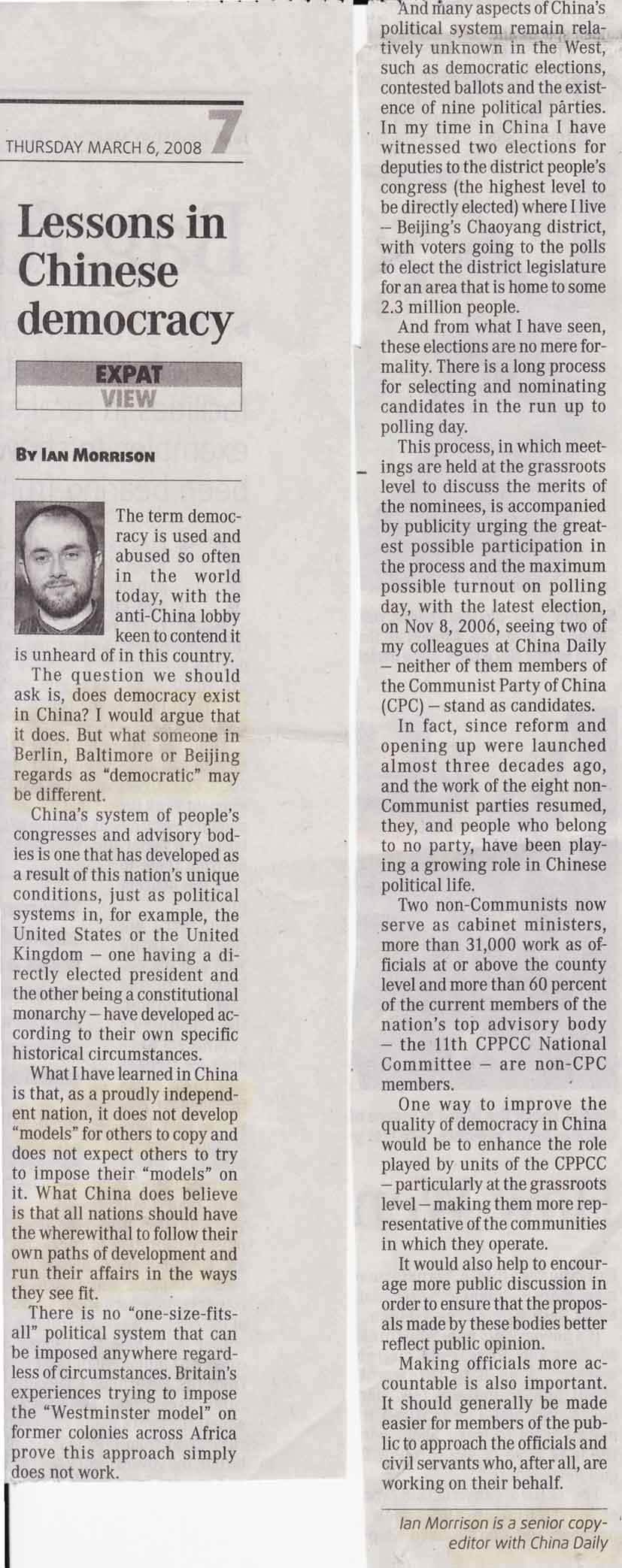
Ian Morrison is a “senior copy editor with ChinaDaily”, which in and of itself is reason enough to hang him from the nearest tree by his dangly bits. The following article was sent to me by a reader in Shanghai, and is reproduced here for your contempt:

Wet Pussy Award - March '08

Did you read it properly? Note the sentence: “…does democracy exist in China? I would argue that it does. But what someone in Berlin, Baltimore, or Beijing regards as ‘democratic’ may be different.” No shit, Sherlock.

And what about: “…as a proudly independant nation, [China] does not develop ‘models’ for others to copy…” Is that right? Really? Tell that to all the poor sods living in the annexed territories, or in the countries that China unsuccessfully invaded over the last 60 years. It’s a long list of places. Tell that to the Taiwanese or Hong Kongers, for that matter.

This article, incidentally, was printed on the same page as a piece explaining that the world should follow China’s model for development.

And for that fact, alone, Mr Morrison, you win this month’s Wet Pussy Award.

Ian Morrison, Wet Pussy Award Winner, March 2008

Posted in China | 5 Comments »

China Daily Reports The REAL Truth

Posted by MyLaowai on Sunday, March 23, 2008

The great dictator and mass murderer Mao Zedong once said that the Party could not survive three consecutive days of bad news, and his teachings were taken to heart by the Chinese Communists. It’s rare, in fact, to have even a single day of bad news for those of us living behind the Bamboo Curtain. If everything we read in the papers was even remotely true, this would indeed be a paradise on Earth.

The recent events in and around Greater Tibet have seriously tested the Party’s propaganda chiefs. The obvious and predictable response has been to shut off virtually all access to outside media, actively block foreign television signals, jam foreign radio broadcasts, and go on a major propaganda offensive inside China. Most Han Chinese, having been trained in how to think since being born, are quite willing to believe everything they are told, and comments such as “We should exterminate all Tibetans” are to be heard almost everywhere.

Naturally, in order to counteract any possible bad news, there must be both denials of the truth, and counter-stories showing something good. I present yesterday’s stories for your enlightenment.

The first, largest headline our friends at China Daily had was:

Lhasa riot reports show media bias in West

Chinese netizens, including students studying overseas, have been angered by biased and sometimes dishonest reports about the recent riots in Tibet by some Western media.

Pictures from some media websites, including CNN and BBC, with untrue reports about the riots have been posted on chatrooms, drawing criticism.

“I used to think the Western media were fair. But how could they turn a blind eye to the killing and arson by rioters?” asked a posting at pic.qikoo.com.

[…]

“To tarnish China’s image, the West is doing whatever they can, no mater how mean and vicious,” said one netizen on http://www.huanqiu.com.

“Is this what they call Western democracy and freedom of speech?” asked another netizen.

Huai Bao, a student studying filmmaking in Vancouver, Canada, said: “I have read some news and online discussions made by those who have never been to Tibet, who have zero knowledge about China and the history of Tibet. These people have no rights to comment on Tibet.”

[…]

Bao said there is a unanimous feeling of anger among his Chinese friends in Vancouver.

“Any news about China has to be negative so that they will believe it – from ‘poisonous toys to poisonous dumplings’. Some foreign media have a particular interest in bashing China over human rights and pollution. They turn a blind eye to all progressive changes.”

And the good news? Check this out:

Oldest Tibetan celebrates 117th birthday

The oldest person in Tibet celebrated her 117th birthday in Lhasa on Sunday.Amai Cering, born in March 16 in 1891, was treated to a celebration of Tibetan entertainment and a birthday cake courtesy of the local government and fellow villagers in Jiarong village, of Linzhou County, Lhasa, on Friday.

[…]

Amai Cering lives on a government pension and donations from local companies. She said she is happy with having meat every day.

She leads a regular life, rising at 8 a.m. and going to bed at 5 p.m.every day, Xiaobai said. She enjoyed sitting in the yard for sunshine and eating four meals a day.

[…]

With economic development and improved medical care in Tibet, the lifespan becomes longer. Linzhou County has four centenarians. The average age in Tibet has risen from 35.5 in 1969 to 67, according to official statistics.

Actually, that part about the increase in life expectancy is probably true – don’t forget that after the Red Army invaded Tibet in 1950, they proceeded to murder half the entire population, whereas these days they tend to murder only a few thousand at a time.

Which brings up a very relevant question:

Now that the Taiwan elections are over and the outcome will not influenced by events in Tibet, and all foreign tourists and journalists have been removed to a safe distance (from whence they cannot observe events in Tibet), how long will it be before the real pogrom starts, do you think?

Posted in China | 64 Comments »

No Witnesses, Please.

Posted by MyLaowai on Friday, March 21, 2008

Posted in China | 14 Comments »

Tibetan Protests

Posted by MyLaowai on Wednesday, March 19, 2008

Sites where Tibetan protests are known to have taken place as of March 17th.

Posted in China | 2 Comments »