Wo Shi Laowai – Wo Pa Shui

This Blog was Invented in Xi'an 5,000 Years Ago

Author Archive

My Wet Pussy Award – August ’08

Posted by MyLaowai on Sunday, August 31, 2008

Poor China. It seems that no matter what it does, it’s wrong in the eyes of the Evil West. Poor China has long been the victim of foreign aggression, foreign discrimination, foreign conspiracies, foreign trade restrictions, and foreign media reporting. Poor China, indeed.

But hang on a moment. Poor China? Hasn’t China in fact been a net beneficiary of bias in all of the above cases? Foreign aggression, for instance: Since the country was founded in 1949 following the Communist Terrorist victory over the legally elected Government, China has invaded or initiated wars with East Turkestan, Tibet, Korea (against the UN), India (twice), Vietnam, Taiwan (Yachen, Quemoy, and Matsu Islands), Burma, and Russia, in the process nearly doubling the size of the country. They have sponsored terror in places as far-flung as Cambodia (Khmer Rouge), Peru (the Shining Path), the Philippines (New People’s Army), and India (Maoist Communist Party), not to mention supporting materially and financially people such as Osama Bin Laden. As for trade issues, China has long been known for an apparent inability to abide by any international agreement or treaty (take for instance the Treaty of Shimonoseki, in which China ceded Taiwan in perpetuity, and which China unilaterally abrogated). Or the opium trade, in which the Chinese Government was the primary force behind the growing, production, refining, selling and exporting of the narcotic substance (but for which the British were blamed when they, too, sold a little in order to try to restore the trade imbalance caused as a result of the Chinese Government’s reneging on international trade agreements). As for discrimination, I feel quite comfortable in saying without any hesitation whatsoever, that there’s no one on earth quite like the Chinese when it comes to discrimination. Really, there isn’t. Hell, I had a three-year-old (!) toddle up to me a couple of days ago whilst I was minding my own business, say “Wai Guo [foreigner]” to me, and try to spit on my foot (in response I picked up the little bastard with my left hand, and with my right gave him a smack on the arse so hard his grandchildren will be bruised, thus confirming that we foreign devils are not to be trifled with). And as for media bias… well, more on that shortly.

What has all this to do with Wet Pussies? In case you were unaware of it, Communist China has just hosted the Summer Olympics. For anyone who missed it, they were given this great honour by those wettest of pussies, the International Olympic Committee. It seemed an opportunity too good to pass up on – we in the West give them this opportunity to prove themselves ready to join the community of nations, and they in return promise to start acting like adults and not kill quite so many of their own people. And that was the deal, make no mistake about it. We in the West kept our side of the bargain…

In a way, it was a marriage made in heaven: the IOC, long known for being one of the most corruptible organisations in the world on the one hand, and on the other, Red China, probably the most brutal dictatorship in human history. Each on their own was utterly beyond contempt, and yet together they seemed to give each other such credibility – no wonder that Jacques Rogges was always so keen to meet his commie buddies in the KTV at Zhong Nan Hai.

Ah, Jacques. What a bastard you are. A lying, crooked, corrupt appeaser and in general terms a complete twat of the first water. I’d dearly love to award you this Wet Pussy Award for services to the Chinese Communist Party.

But unfortunately, I can’t.

Because, you see, there’s an even more deserving recipient, and that would be the Western Media, those same people who are so regularly accused of showing unfair bias against Poor China.

Oh sure, there are a few journalists and reporters who do know their topic, and who are not afraid to write the truth. Sadly, though, they are few and far between. For those of you who might read this, please understand that I value you all the more for it.

Let’s just go back to my opening remarks, shall we? When, in all those events, did China ever get the caning it so richly deserved from our media? Somehow, they’ve always managed to squeak through smelling, if not of roses exactly, at least not like the dogshit that they are. For hundreds of years they’ve had the benefit of doubt, they’ve been the poor underdog who just needed to be given a chance and a little encouragement, the child who always got let off lightly when he didn’t play well with others. And then they got the Olympics, and the harsh glare of the international media spotlight was upon them. And we let them off the hook again!

“Greece won the gold medal in doping”, said Jacques Rogges, and his words were faithfully reported around the world. But, how many reporters mentioned that the Greek athletes in question had had their dietary supplements laced with steroids, quite deliberately, by the Chinese company that produced them?

“Keep politics out of sport”, cried the Chinese Propaganda Ministry, and the media picked up the tune. How many reporters mentioned, even in passing, that China had boycotted more Olympics than any other nation in history?

“Protest Zones have been established in Beijing”, announced the Chinese Security Services, and the media loved it. Very few made much of a deal about the fact that not a single protest was ever approved, and that many of the applicants were taken directly to a slave labour camp for re-education.

Rogges again: “For the first time, foreign media will be able to report freely and publish their work freely in China. There will be no censorship on the Internet.” And our media loved that one. Well then, why didn’t they use the opportunity to exercise their new-found freedom, and report on the plight of the millions of people who are currently in Laogai slave labour camps for Re-education Through Hard Labour, and who are quite outside any legal system. Or report on the vast number of people who were sent to live in the countryside, so as to hide Beijing’s true squalor from the gaze of any Olympic visitors? How many reports did you read quoting stories of horror from the lips of Tibetan victims of torture and oppression? How many Uyghur’s were interviewed for their views on the illegal Chinese occupation of their country? I didn’t read a single report highlighting the fact that the face on the money is that of Mao Zedong, the greatest murderer in all of human history, who was proudly responsible for the deaths of more people than Hitler and Stalin combined? Did you just happen to miss that one, did you, media hacks?

Western Media, you are the people we trust to give us the truth, and who are, by dint of the sacrifices made by our forefathers, in a unique position to be allowed to do so. You have let us down again. You have conspired to support China once more at the expense of the truth, and for this you deserve nothing less than this Wet Pussy Award.


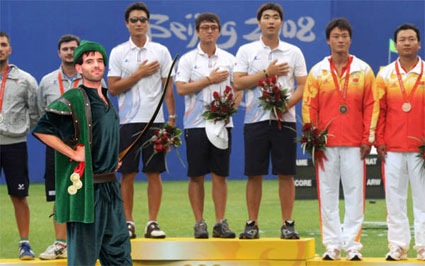
Oh yeah, and in case anyone thought I’d forgotten it, here’s yer Pair of Tits for August, while I’m at it:

Posted in Human Rights, Media, Propaganda, Wet Pussy Awards | 17 Comments »

Green-Clad Archer Steals Gold From Rich, Gives To Poor

Posted by MyLaowai on Thursday, August 21, 2008


BEIJING—Chinese Olympic officials say they are no closer to catching the swashbuckling, green-uniformed archery competitor who has disrupted every single medal ceremony of the Games by bursting in, stealing the gold medal or medals in the name of the poor in an archery-related fashion, striking a triumphant pose, and then disappearing without a trace.

“Good people of the world, take heart!” the mysterious figure said in his most recent appearance, when he burst into the medal ceremony for the Men’s 200 Metre Freestyle. “Truly, these are good men, doughty and true; and their swimming has won the day. First place in the very world may they rightly claim, but in the name of the poor, the sickly, the lonely old, and the weak without voice, I hereby claim this gold that with it I may do greater good!”

The archer then shot a goose-feathered arrow through the ribbons holding the gold medals around the necks of the U.S. team, causing their medals to fall to the ground. The archer himself proceeded to leap from the rafters, alight on the podium’s top step, collect his prize, and disappear through a nearby window.

Since entering China last month by using a forged Sherwood Forest passport under the name Robert Huntingdon, the archer has appeared at more than 70 medal ceremonies, escaping with the gold every time. In almost every case, archery-related schemes were used to secure the medals, although some were more difficult for him to obtain than others.

An epic four-way fencing match broke out during the Women’s Sabre medal ceremony, with the archer taking on the three American women in a clash of blades that spilled out onto the balcony and across the Beijing rooftops. Germany’s Ole Bischoff, winner in the Men’s 81kg judo event, threw the archer through a nearby table and down a flight of stairs before his feet were nailed to the ground by arrows. And the Chinese women’s gymnastics team was almost impossible for the archer to catch.

The athletes themselves are divided in their opinion of the bow-weilding outlaw. Although many regard him as annoyance at best, and still others as a dangerous menace, a considerable faction has voiced sympathy for his cause.

“Put it this way—that guy has some stuff of mine, but he’s welcome to it,” said U.S. swimmer Michael Phelps. “I mean, I’m not political, really, but I’ve had a lucky life. If my gold medals can help someone get a hot meal and a place to sleep for a few nights, that’s okay. It doesn’t mean I didn’t win.”

Phelps confessed his admiration that, although the archer had burst into the ceremony for the men’s 400 Meter Relay, the team had been allowed to keep a single medal, as the archer praised the “epic performance by four doughty good men and true, who soundly defeated the Norman French, uplifted the hearts of all who saw, and enriched the very World thereby.”

Chinese officials have been less charitable. “His disregard for our culture, our laws, and these Games will not go unpunished,” a statement from the Chinese Olympic Committee read in part. “We demand he turn himself in, return the medals to the rightful winners, and face his punishment for these thefts, as well as for his repeated demands that we free Tibet and his continued poaching of deer in Yu Nan province.”

Law enforcement officials, acting in liaison with the Nottingham Sheriff’s Department, have also concocted a scheme to capture the elusive archer by staging an archery contest with an especially large and valuable gold medal as the prize, an event already under way. The contest is currently in the semifinal rounds and is being led by Britain’s Rob Enhood, a mysterious eyepatched figure with a penchant for archery so accurate that he routinely splits the arrows of his competitors.

– Reporting by The Onion

Posted in China | 1 Comment »

ONN Breaking News!

Posted by MyLaowai on Wednesday, August 20, 2008

Deadly Virus Sweeping China Is Just Olympic Fever

The Chinese government explained that the fatal disease is caused by the excitement of the Olympics, not infected birds, as was previously reported.

Posted in China | Leave a Comment »

Olympic FAQ

Posted by MyLaowai on Sunday, August 17, 2008

…and now this extract from the Olympic Website Since Ancient Times:

Olympic FAQ for Foreign Friends

1. I’ve been hearing a lot about these pollution levels, but there are so many different ways the experts use to describe it all, and so much fancy jargon, that I’m a bit confused. Can you please tell me what is the standard that Beijing must meet to determine whether it is a “blue sky day”?

Certainly. It is a “Blue Sky Day” if the sky is Pantone 444M or better.

2. Is there an official Olympic song?

Indeed yes! There is an official song, and it will be sung at every event before athletic activities commence, before and after every medal presentation, in the taxi on your way home to your hotel, during the night in your hotel room, from loudspeakers along every street, and from the micro-radio that will be implanted in your teeth at the airport during customs inspection. It’s a lovely little ditty, too. Here it is:

Ni ke Cen Jian Guo Yi Wei Xiao Jie?
Yi Wei Xiao Jie.
Yi Wei Xiao Jie?
Ni ke Cen Jian Guo Yi Wei Xiao Jie?
Wang Zhe Bian Zou he Na Bian Zou?
Wang Zhe Bian Zou he Na Bian Zou
Na bian Zou he Zhe Bian Zou
Ni ke Cen Jian Guo Yi Wei Xiao Jie?
Wang Zhe Bian Zou he Na Bian Zou?

3. What’s the deal with the mascots? Why so many, and what are they called anyway?

Actually, there is some confusion regarding both the name and number of Olympic mascots at the 2008 Genocide Olympic Games. Originally, there were five mascots, however one defected from the team. Sadly, therefore, Yingsel will not be present. As for their names, the mascots have been variously referred to as Funtwo, Fuzbol, and even Futzpah. Most foreign media have now settled on the term Fuwa, which is unfortunate, as the term has the same sound in Chinese as scrotum.

4. What’s the best way to support the athletes from my own country, without hurting the feelings of all the Chinese People?

You must take extreme care at all times to avoid hurting the feelings of all the Chinese People. This includes such things are not arguing over prices (which suggests that you think the honest merchant you are dealing with might not be 100% honest), not pushing in front of Chinese People in queues, or bringing up the subject of your incorrect understanding of history. In an effort to help you out, the Chinese Communist Party has hired people to cheer for your athletes on your behalf, in order that you will not run the risk of hurting anyone’s feelings. These ‘Cheerers’ are expected to be so diligent, that you in fact will not be required to attend any of the actual events in person, which is why your Visa application has been denied.

5. Will the foreign media be allowed to cover my favourite events?

Of course they will. You will be able to freely watch Ping Pong, Badminton, and Air-Pellet Shooting, as well as any other event in which China wins a medal. In case you miss it the first time, regular repeats will be scheduled.

6. What is the IOC doing to stop drug cheats?

The IOC has full confidence in the Chinese Communist Party’s ability to closely monitor any relevant situation, according to certain relevant Laws. The Chinese Team has already said that they are clean, and so obviously the job of catching cheats will now be confined to catching the foreign cheats who manage to win any medals. Some foreigner cheats have already been caught, when the company in Guangdong that produces their food confirmed that it was laced with anabolic steroids.

7. Where can I buy tickets?

You can purchase tickets from scalpers outside any Olympic Venue. The tickets will not help you to actually get in, but then as a laowai that should hardly come as a surprise. A better bet, would be to have parents who are members of the Chinese Communist Party.

8. Where is a good place to stay during the Olympics?

Home.

9. Where can I go to Party party in Beijing?

That will depend very much on whether you look like you might have come from a certain continent whose resources are being plundered by a certain Asian nation. If so, you will have a wonderful chance to party at Zhengding Detainment Center. If you are instead from Western, then the bars will be closed anyway, in order to show stable and calmly. No dancing, prease.

10. What can I do to show my support for One World, One Han Dream?

Simply this: Do not display Evil Motives against the peaceful People’s Liberation Army and 5,000 years civilisation of China.

Welcome to China, wish you happy happy everyday!

Posted in China | 2 Comments »

How my lungs coped with a 10k run round Beijing

Posted by MyLaowai on Tuesday, August 5, 2008

Don’t worry about the pollution, the Beijing authorities have been telling us.

Factories will shut down. Cars will be taken off the roads. Skies will be seeded with silver nitrate and clouds conjured away to leave the air perfect for the world’s athletes.

That’s the theory. Happy to lay my lungs on the line in the name of unscientific research, I decide to head out into the city on a long run to test conditions first-hand.

The initial signs are disconcerting.

As I jog down the stairs and out into Monday morning, the concrete tower-blocks of the Green Homeland Media Village are shrouded in what looks like a heavy autumnal fog.

Even with the sun completely hidden away in the grey blanket up above, the heat is intense.

Traffic is roaring by on the Beiyuan Lu expressway, soldiers in pale khaki shirts and white gloves marching in rectangles around the security barriers. I wave at a group of staring schoolkids and head south towards the Olympic Green.

Five minutes down the road, my t-shirt is already drenched, hanging heavy off my shoulders.

It’s 9am. At this time of day, the Olympic marathon runners will still have seven or eight miles to go.

The triathletes won’t even be starting the run leg of their races for another three hours.

I pass a woman whose mobile has an Axel F ring-tone and realise that my throat has started to feel sore, as if I had a cold coming on.

Maybe it’s the road I’m running alongside, I think, and head down a side-street in search of a patch of greenery.

Another five minutes down the line, there’s a strange lumpy feeling halfway down my throat. An old chap watering a freshly-planted verge hawks up a fat lump of phlegm and flobs it expertly into a plant-pot.

When in Rome, I think, and spit into the gutter with relish. The metallic taste in my mouth remains.

It’s not easy working out where to go. The haze obscures anything more than 100m away. I’ve picked a bad day – today the BBC reading registers 292 micrograms of particulate matter per cubic metre (the World Health Organisation target is 50).

I’d planned to aim for the Bird’s Nest Stadium 5km away, but there’s as much chance of me spotting it in these conditions as there is of me doing the pole vault there in 10 days’ time.

The road stretches into the gloom, the two dedicated Olympic lanes completely empty of traffic while buses and bikes fight for position in the other lane.

“One world, one dream,” read the banners flapping from the lamp-posts. My map shows a large park off to the left, but everywhere you look are tall fences and short officials with strict instructions to keep you out.

At the halfway stage, my eyes have started to feel gritty, as if I’d been out all night in a club full of smokers. Three weary-looking blokes slumped on a bench ni-hao in my direction as I rub my eyes and I ni-hao back.

The stinging in my throat gets worse as I head back north, the Bird’s Nest lost somewhere in the smog.

Towers of apartment blocks loom slowly out of the mist. Young blokes on mountain-bikes pedal past while shouting into mobiles, which at least makes me feel more at home.

Every now and then a solitary soldier stands on a small plinth, staring into a seemingly random direction with a blank expression.

My lungs feel half their normal size. No wonder an asthma sufferer like Haile Gebrselassie decided to sack off the Olympic marathon, even though he’s the world record holder.

The only other time my lungs have felt this bad was when I got stuck behind a brigade of belching buses while foolishly cycling down Oxford Street.

By the final few miles I’m dragging my legs along like sandbags. There could be several reasons for that – seven hours of jet-lag, the cannonball-like lump of egg-fried rice lodged halfway down my digestive tract, a delusional attitude towards my own fitness – but I’ve also taken it incredibly easy.

How much worse would I be feeling if I’d really opened the lungs up and got my heart-rate going?

At the end I’m coughing like a 20-a-day man. It’s like I’ve borrowed the lungs of my colleague Ben Dirs – and if you’ve ever seen Dirsy trying to walk up a flight of stairs, you’d know that’s a very bad thing indeed.

In the long list of cities that you’d never want to run in again, the competition is fierce.

Choosing between the traffic-choked hell of San Salvador or the dusty madness of Delhi, for example, is almost impossible, while a man can lose so much fluid in sweat in Kuala Lumpur that he’ll grow a beard before he visits a urinal again.

Until today, however, I’d always considered Cairo to be out there alone at the top of the pile.

Not any more. And when would they ever stage an Olympics in Cairo?

Tom Fordyce

Posted in China | 4 Comments »

My Wet Pussy (Musical Interlude)

Posted by MyLaowai on Thursday, July 31, 2008

Crikey Bruce! It’s well into August, and I still haven’t done anything about July’s Wet Pussy Award. In fact, there is a winner for July, but he/she/it is going to have to wait now until September (seeing as how August’s winner will almost certainly be an Olympics journalist visiting China for the first time).

In the meantime, let’s take a look back at a few previous holders of the trophy…

There was the inaugural winner, Daniel Newham. He truly is a cun… wet pussy, and won January’s award for his services to the Han Regime and their policies in occupied East Turkestan. February’s winner was the ‘Superstar Entertainer’ David Wu, who makes my life hell whenever I take a taxi in Shanghai. March’s award went to Ian Morrison, for his instructive insights into Chinese Democracy. April’s winner was Kim Beasley, but as he’s a politician, that should come as no shock. May starred the Un-Named Twat, for his habit of extorting money from other foreigners in collusion with the local goons and thugs (a.k.a. Police). June of course gave us Barry, who won because, well, because he is Barry.

What a line up, eh folks? Wet pussies, every one. And what should we do with Wet Pussies?

This.

Posted in Wet Pussy Awards | 1 Comment »

China, the Olympics and the Visa Mystery

Posted by MyLaowai on Wednesday, July 30, 2008

Something extraordinary is happening in China, and we are not talking about the Olympics. Rather, Chinese officials have been clamping down on visa applications and implementing bureaucratic impediments to new and renewed visa applications under the guise of pre-Olympic security.

In some ways, Beijing’s plan for a safe and secure Olympics appears based on the premise that if no one shows up, there can be no trouble. But placing restrictions on the movement of managers and employees of foreign businesses operating in China, even if for a limited time as Chinese officials have been at pains to reassure, makes little sense from the standpoint of gaining political and economic benefits from hosting the Olympics. Something just isn’t right.

The Post-’70s Economic Framework
Since China’s economic reform and opening in the late 1970s, China’s economic policy — and thus the basis for the overall development of the nation — has been based on a simple two-part framework. First, draw in as much foreign investment as possible and use the money and technology to strengthen China while using the subsequent economic leverage to secure China. And second, encourage growth for growth’s sake to ensure an ever-increasing flow of money through the system to provide employment and social services to a massive and urbanizing population.

Key to this policy has been creating a very open environment for foreign businesses, which bring money, technology and expertise and use their influence with their own governments to keep stable international relations with China — hence reducing international and economic frictions and increasing the efficiency of the supply chain. For more than two decades, Chinese national strategy has thus revolved around the principle of encouraging investment, joint ventures and wholly-owned foreign enterprises in China. There have been two foundations for this strategy: the evolution of financial facilities for transferring and controlling foreign money with a level of transparency nearing international standards, and the ease of movement of personnel in and out of China.

It is this latter point that recently has been hit the hardest. Over the past several months as the Beijing Olympics drew nearer, the Chinese government has effectively frozen up most financial reform plans. It also has issued a raft of new security measures not entirely unlike other host cities in the post 9/11 security environment. But China has gone several steps further than its predecessor hosts, placing official and bureaucratic impediments on visa applications. This not only has targeted potential “troublemaking” rights advocates, it has also impacted foreign businesses ranging from invited guests to the Olympic games to managers and employees of foreign companies in China.

Business and the New Visa Hassles
The visa restrictions in particular have been a source of angst for foreign businesses and business associations. Many smaller operations may circumvent Chinese regulations and travel on tourist visas (provided they can still obtain them). And there are ways around the tighter regulations or bureaucratic hurdles if one has the right connections or the willingness to apply several times or from different locations. But multinational corporations are less willing to jeopardize their operations by skirting the laws. Instead, they are making their concerns known to Beijing and hoping that restrictions are eased in September, as Beijing has rumored and hinted will occur.

In general, these visa restrictions have been brushed aside by foreign observers as simply paranoia on China’s part regarding protests or terrorist attacks during the Olympics. In many ways, however, this makes little sense. First and most obvious, the Olympics were supposed to highlight the opening of China — not restrict the very people who have made China a key part of the global economy. Second, imposing tight restrictions in Shanghai, the center of the Chinese foreign-domestic economic nexus, makes little sense on grounds of Olympic security since Shanghai is playing only a minor role in the games compared to Beijing and Qingdao. (Think shutting down visas to New York during the Atlanta games in the name of security, though Shanghai admittedly is hosting some soccer matches.)

Shutting down business visas to keep terrorists out makes little sense anyway — it is hard to imagine Uighur militants traveling on business visas as representatives of foreign multinationals. Furthermore, by restricting business visas — even if not across the board in a coherent fashion — China is putting a massive strain not only on the ability of businesses to trust Chinese regulations and business relations with the government, but also on the fluidity of the global supply chain. Shutting down or impeding visas affects much more than delaying the movement of a single individual into China; it impacts the ability of multinational corporations to move, replace or supplement managers and dealmakers in China. A delayed visa applications of just three months still represents an entire quarter that multinational corporations cannot reliably manage their businesses operations i n China, and that doesn’t take into account the visa backlog when restrictions are loosened or lifted.

Disrupting an integral part of the global economy for a full quarter because of an international exposition makes little sense. The Germans in 1936 didn’t do it, the Russians in 1980 didn’t — no one has. One doesn’t simply shut down international business transactions for three months or more to stop a terrorist — and particularly not China, which depends on foreign direct investment. This is not simply an inconvenience for some people: It is the imposition of friction on a part of the system that is supposed to be frictionless. And it is not merely individuals who are affected, but the relations between mammoth companies.

A Period of Erratic Policies
China’s behavior has been erratic for several months now, if not for the past few years, with the implementation of new and often contradictory security and economic policies. These have all been brushed aside as somehow related to preparation for the Olympics. But they are in fact anomalous. China’s behavior is not that of a country trying to show its best side for the international community, nor that of a nation simply concerned about potential terrorist or public relations threats to the Olympic games. In another two months, after the Olympics and Paralympics have ended, it will become clearer whether this was a spate of excessive paranoia or a reflection of a much more significant crisis facing the Chinese leadership — and the evidence increasingly points toward the latter.

As mentioned, China’s economic policies in the reform and opening era have been based on the idea of growth. This in many ways simply reflects the Asian economic model of maintaining cheap lending policies at home, subsidizing exports, flowing money through the system and focusing on revenue rather than profits. In essence, it is growth for the sake of growth. This was the policy of Japan, South Korea, Indonesia, Malaysia and Thailand. And it led each of those countries to a final crisis point, striking Japan first in the early 1990s and the rest of the Asian tigers a few years later. But China managed to avoid each of the previous Asian economic crises points, as it was on the lagging end of growth and investment curves.

Following the Asian economic crisis, China fully recovered from the international stigma of Tiananmen Square and became the global economic darling. By the time the 21st century rolled around, China was already taking on the mantle of the Japanese and other Asians. It began to be labeled both an economic miracle and a rising power; a future challenge to U.S. economic dominance with all the political ramifications that brought. Were it not for 9/11, Washington would have squared off with Beijing to prevent the so-called China rise. The reprieve of international pressure that came when U.S. attention turned squarely toward Afghanistan and then Iraq freed China’s leaders from an external stress that could have brought about a very different set of economic and political decisions.

With the United States preoccupied, and no other major power really challenging China, Beijing shifted its attention to domestic issues, and its review quickly revealed the stresses to the system. These did not primarily come from “splittist” forces like the Tibetans or the Falun Gong, but rather from the economic policies that had brought China from the Third World to the center of the global economic system. Beijing is well-aware that should it continue with its current economic policies, it will face the same risk of crisis as Japan, South Korea and the rest of Asia. It is also aware that growing internal challenges — from the spread and invasiveness of corruption to geographic economic imbalances, from rising social unrest to massive dislocation of populations; are causing immediate problems.

Economics from Mao to Hu
Mao Zedong built a China designed to be self-sufficient and massively redundant. Every province, every city, every factory was supposed to be a self-contained unit, making the country capable of weathering nearly any military attack. Deng Xiaoping didn’t get rid of these redundancies when he opened the economy to foreign investment. Instead, he and his successors encouraged local officials to work to attract foreign investment and technology so as to raise China’s economic standard more rapidly. By the time Jiang Zemin was in power it had become clear that the regionally and locally driven economic policies threatened to throw China back into its old cycle of decentralization — and, ultimately, competing centers of power. Attempts by Jiang to correct this through the Go West program, for example, came to naught after meeting massive resistance in the wealthy c oastal provinces. The central government accordingly backed off, shifting its attention to reclaiming centralized authority over the military.

Hu Jintao has sought once again to try to address the problem of the concentration of economic power in China’s coastal provinces and cities through his Harmonious Society initiative. The idea is to redistribute wealth and economic power, regain central authority over the economy, and at the same time reduce redundancies and inefficiencies in the Chinese economy. With minimal external interference, Hu was able to test policies that by their very nature were going to sacrifice short-term social stability in the name of long-term economic stability. Growth was replaced by sustainability as the target; longer-term redistribution of economic growth engines would replace short-term employment and social stability.

This was a risky proposition, and one that met strong resistance in China. But the alternative was to sit back and wait for the inevitable economic crisis and the social repercussions thereto. In some ways, Hu was suggesting that China risk stability in the short term to preserve stability in the long run. But Hu didn’t anticipate the massive surge in global commodity prices, particularly of food and oil. This was compounded by increased international scrutiny over China’s human rights record ahead of the Olympics, natural disasters hitting at the availability and distribution of goods, a rise in domestic social unrest triggered by local government policies and economic corruption, several attempted and successful attacks against China’s transportation infrastructure, and the uprising in Tibet. Thus, the already-risky policies the central government was pursuing suddenly looked more destructive than constructive from the point of view of continued rule by the Communist Party of China (CPC).

The global economic slowdown was the external impetus China feared — something that could undermine the flow of capital and leave Beijing unable to control the outcome of a reduction in the inflow of capital. At the same time, the internal social tensions triggered both by Hu’s attempts to reshape the Chinese economy and by the slow pace of those changes created a crisis for the Chinese leadership. It was hard enough internally to control a measured economic slowdown to reshape the economic structure of China, but quite another thing altogether to have such a slowdown imposed on China from outside at the very moment social stability was in a critical state at home.

A Government in Crisis
China’s rapid and contradictory economic and security policies, rising social tensions, and seemingly counterproductive visa regulations appear to be signs of a government in crisis. They are the reactionary policies of a central leadership trying to preserve its authority, stabilize social stability and postpone an economic crisis. At the same time, we see signs that the local governments, and even organs of the central government, are putting up steady resistance to the announcements coming from Beijing. Slapping restrictions on foreign businessmen may make little sense from a broader business continuity sense, but if the point is to begin breaking the backs of the local governments — whose strength lies in their relations with foreign businesses — then the moves may make more sense.

If the central government has reached the point that it is willing to risk its international business role to rein in wayward local officials, however, then the Chinese leadership sees a major crisis looming or already under way. It is one thing to toss out a few local leaders and replace them, quite another to undermine the structure of the Chinese economy for the sake of regaining control over local officials. But if Chinese history since 1949 (and really quite a ways before) is any guide, the core of the CPC leadership is willing to sacrifice social and economic stability to preserve power. One need only look at the Great Leap Forward, the Cultural Revolution or the crackdown at Tiananmen Square for evidence of this. Revolution is not, after all, a dinner party, and maintaining CPC control is paramount to the government.

After each major revolution or crisis, China eventually has recovered. The Cultural Revolution was followed by diplomatic relations with the United States, Tiananmen Square was put aside as China joined the World Trade Organization and surged ahead in gross domestic product (GDP). Certainly, there was change among the leadership and in the way the party dealt with policies at home and abroad. But if there is the likelihood of loss of control due to an impending economic crisis, better to have some role in shaping the crisis to preserve the chance of maintaining a role in the future political structure than to sit by and try to clean up as things fall apart. The Party in fact has a long history of taking a self-generated crisis/revolution over an externally or domestically initiated one.

It may be that the contradictory policies Beijing is tossing around these days will simply fade away after September and things will get back to “normal.” But already, Chinese officials are downplaying the previously hyped political and economic benefits of the Olympic games. They are now warning that economic conditions may not be so strong in the future, and at least internally discussing the distinct possibility that at least certain regions of China are facing the same economic crises faced by their mentors Japan, South Korea and the Asian tigers.

Internal Crises vs. the Economy
A recent article in the Global Times, a paper that addresses myriad topics of domestic and international significance and is read among China’s leaders, discussed how economics is not the best measure of strength. It referred to the overall comparative GDP and the size of China’s military in the late 1800s. Then, China was considered at its weakest, but from an economic or military perspective it could have been considered comparable to the global powers of the day. This hints at the deeper internal debate in Beijing, where true national strength and the role of the economy is under discussion. Assumptions that China is only focused on continued good economic ties with the world shouldn’t be taken as gospel — China has a track record of shutting down external connections when internal crises brew.

Numerous polices are being thrown around in firefighting fashion, including blocking or at least hindering foreign business movement in and out of the country and tightening the flow of foreign capital in both directions. They are coming in reaction to flare-ups in economic, environmental, public relations and social arenas. Energy policies are making less sense, imbalances in supply and demand are growing and seemingly contradictory policies are being issued. Social unrest, or at least local media coverage of such unrest, seems to be increasing; either is a sign of weakening control. Local officials are still failing to fall in line with central government edicts. Strategic state enterprises like China National Petroleum Corp., China Petroleum & Chemical Corp. and the China Development Bank are all defyi ng state-council orders — and the State Council itself is apparently going head-to-head with major policy bodies long given control over economic policies.

Something extraordinary is happening in China. And while not everyone may want that to be the case, and so have sought to use the Olympics to explain things away, the easy explanation simply doesn’t make enough sense.

Stratfor

Posted in China | 13 Comments »

ChinaDaily Headlines, 29th July 2008

Posted by MyLaowai on Tuesday, July 29, 2008

Those colourful liars over at the Party mouthpiece, ChinaDaily, have been at it again:

Beijing denies suspension of issuing visa letters

The Beijing municipal government Monday denied reports in the foreign media that said it had stopped issuing official invitation letters for business visas to foreigners.

“Some foreign media have reported that the Beijing municipal bureau of commerce (BMBC) has stopped issuing official invitation letters, known as notification letters, needed for business visas. But the fact is we never did so,” Zhao Hui, a BMBC official, said.

I have just finished talking to a friend who is directly involved in the visa-issuing process, and he tells me that they have received very clear instructions from the Party, NOT to issue official invitation letters for business visas to foreigners. In fact, for the next few weeks, all business visa applications for foreigners are to be denied out of hand.

I guess that means I caught you making a bold-faced lie, Zhao Hui.

In other news, Hong Kong has just recorded its worst ever day of atmospheric pollution – 202 on the Air Pollution Index. Olympic equestrian competitors, however, are not worried:

“We have no concerns at all. These are the horses that we flew over from Florida, where it’s been 37 and 38 degrees for the last few weeks,” said Canadian team leader Michael Gallagher. “We’ve noticed the haze, but it’s not black like it is in Beijing.”

Posted in China | 1 Comment »

POTIF

Posted by MyLaowai on Friday, July 25, 2008

Posted in China | Leave a Comment »

Gotcha!

Posted by MyLaowai on Tuesday, July 22, 2008

Well, it would appear that the good guys have finally caught Radovan Karadžić, the former Serb leader who was indicted for war crimes by the International Criminal Tribunal for the former Yugoslavia (ICTY) in The Hague.

He was responsible for the deaths of over 100,000 people, and caused a vast amount of suffering throughout the region. Many of the scars will never heal. This is what he is charged with:

* Two counts of genocide (Article 4 of the Statute – genocide, complicity in genocide);
* Five counts of crimes against humanity (Article 5 of the Statute – extermination, murder, persecutions on political, racial and religious grounds, persecutions, inhumane acts (forcible transfer);
* Three counts of violations of the laws or customs of war (Article 3 of the Statute – murder, unlawfully inflicting terror upon civilians, taking hostages);
* One count of grave breaches of the Geneva Conventions (Article 2 of the Statute – wilful killing).

So now they have him, it’s only a question of whether he is tried at home, or in The Hague.

His capture follows that of Slobodan Milošević, former Serbian President and close friend of that other well-known butcher Jiang Zemin. The peeps over at Wikipedia had this to say on that particular subject:

Milošević first visited China in the early 1980s while head of Beobank. Milošević visited China again in 1997, after an invitation by Chinese president Jiang Zemin. Milošević was often popularly known in China by the nickname “Lao Mi” (老米), a shortened form of the informal Chinese-style nickname “Old Milošević” (老米洛舍维奇); among the state-operated media in China, Milošević was often referred to as “Comrade Milošević” (米洛舍维奇同志). Many sources hold that the Chinese government asserted strong backing of Milošević throughout his presidency until his surrender, and was one of the few countries supportive of him and the Yugoslav regime, at a time when most Western countries were strongly critical of the Milošević government. The New York Times states that China was “one of Mr. Milošević’s staunchest supporters” during the Kosovo conflict. China vocally opposed NATO armed intervention in Kosovo throughout the campaign. Chinese parliamentary leader Li Peng, was presented by Milošević with Yugoslavia’s highest medal (the Great Star) in Belgrade in 2000.

The New York Times observed that Milošević, and particularly his wife Marković had “long viewed Beijing and its Communist party” as allied and “the sort of ideological comrades” lacking in Eastern Europe after the fall of Communism in the 1990s. After Milošević’s indictment, China’s public statements shifted toward emphasizing Yugoslav-Chinese relations rather than focusing on its support for Milošević, while after the election of Vojislav Koštunica as Yugoslav president, Chinese foreign ministry officially stated that “China respects the choice of the Yugoslavian people.”

Nice, huh?

It appears that the world is starting to make an effort to punish those guilty of crimes against humanity – it was just a few days ago that prosecutors at the International Criminal Court (ICC), filed ten charges of war crimes against Sudan’s President Omar al-Bashir, three counts of genocide, five of crimes against humanity and two of murder. So when, I am wondering, will they get around to catching this guy (known to the Tibetan people as the Butcher of Lhasa):

Posted in China | 8 Comments »